
Muscle Building Nutrition: Protein, Calories and Timing
Contents
How does muscle growth work?
Building muscle takes two prerequisites at the same time: a training stimulus that is strong enough, plus the building blocks and energy to respond to it. If one of the two is missing, little happens, no matter how good the other is.
The stimulus comes from strength training, specifically through progressive overload, meaning the regular increase of weight, repetitions or difficulty. How to build that up systematically is covered in our guide Strength Training for Beginners, and how to turn it into a plan with progression in our guide How to Create a Training Plan. Nutrition provides the material: protein for the muscle fibers and enough total energy for your body to prioritize growth in the first place.
It’s important to understand that the growth itself doesn’t happen during the workout but afterward, during recovery. That’s why sleep and rest days are just as much a part of the concept as meals. If you train six times a week, eat too little and sleep poorly, you have all three factors working against you.
How much protein do you need?
The proven range for building muscle is 1.6 to 2.2 grams per kilogram of body weight per day. At 75 kilograms that’s about 120 to 165 grams a day. More usually brings no additional benefit; less noticeably slows muscle growth.
More important in practice than the exact number is the distribution: 3 to 4 meals, each with a clear protein source, work better than one big portion in the evening because your body gets the growth stimulus several times across the day. A simple rule of thumb for daily life: every main meal gets a palm-sized portion of protein source, plus protein-rich snacks like quark or skyr.
A note for anyone who wants to slim down at the same time: in a calorie deficit, enough protein is even more important because it protects the muscle you already have. The details are in our guide Weight Loss, and the math for your needs and deficit in our guide How to Calculate a Calorie Deficit.
How big should your calorie surplus be?
For muscle growth you need a moderate surplus of about 200 to 400 calories per day above your total daily energy expenditure. That is enough for growth and keeps fat gain in check.
| Daily surplus | Assessment | Suitable for |
|---|---|---|
| 0 kcal (maintenance) | Muscle growth only possible to a limited extent | Beginners, people returning to training, higher body fat percentage |
| approx. 200 to 400 kcal | Moderate, a good standard | Most muscle-building goals |
| approx. 500 to 700 kcal | Significant, more fat gain | Very lean people, short building phases |
| over 1,000 kcal | Not sensible | Leads mostly to fat gain |
The classic misconception is that eating a lot automatically leads to a lot of muscle. In reality the rate of muscle gain is biologically limited: about 0.5 to 1 kilogram of muscle mass per month is realistic for beginners under good conditions, and significantly less for advanced lifters. Everything you eat beyond that need ends up as body fat and has to be trained off again later.
Check your surplus using the scale and the mirror: a gain of about 0.25 to 0.5 percent of your body weight per week is a good benchmark. If it’s clearly faster, the surplus is too high. What your total daily energy expenditure is made up of is explained in our guide Boost Your Metabolism.
Nutrition and training in sync
Many coaches on nucoach offer training and nutrition support as a combination package, usually cheaper than booking both services separately: personal training in Berlin, nutrition coaching in Berlin and nutrition coaching in Hamburg.
How do you split carbohydrates and fats?
After protein, the simple rule is: carbohydrates provide training energy, fats secure your hormone balance. As a guideline, about 20 to 30 percent of total calories should come from fat, with the rest split between protein and carbohydrates.
Carbohydrates are stored in the muscle as glycogen and are the most important fuel for intense strength sessions. If you cut them too much, you notice it right away in your training performance, and less performance means less stimulus means less growth. Good sources are whole-grain products, potatoes, rice, oats, fruit and legumes.
Fat shouldn’t fall below about 20 percent of total energy because it’s involved in hormone production and transports fat-soluble vitamins. Choose oils, nuts, seeds, avocado and fatty fish. A practical point: at over 9 calories per gram, fat is the most energy-dense source, which helps in a building phase but quickly becomes a problem in a deficit.
Which foods deliver best?
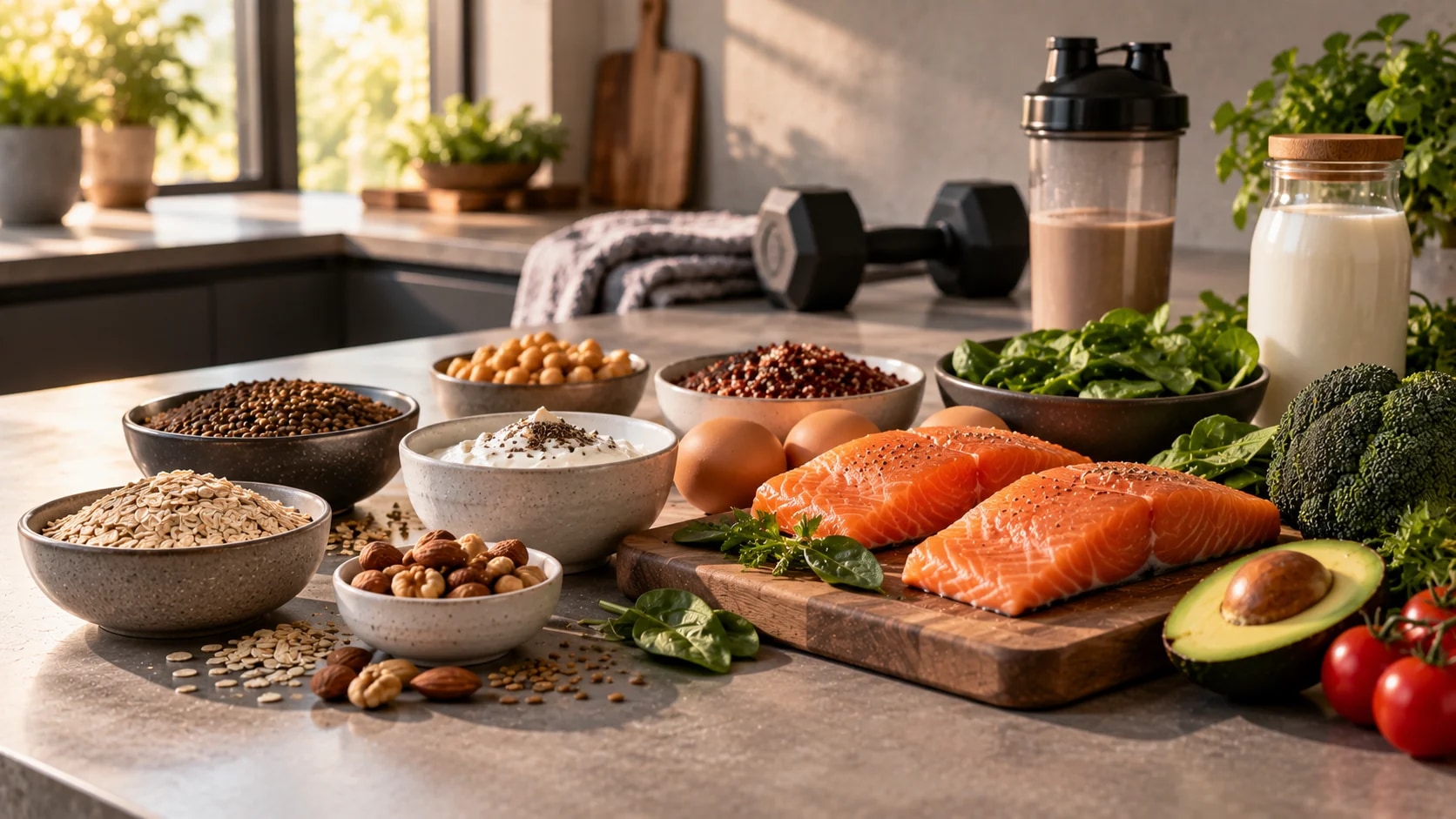
The most efficient protein sources for everyday life are quark and skyr, eggs, fish, lean meat, legumes, tofu and soy products. They provide plenty of protein for a manageable number of calories and are easy to fit into daily life.
For complete nutrition, combine them with carbohydrate sources (oats, rice, potatoes, whole-grain bread, pasta), fat sources (olive oil, nuts, avocado, salmon) and plenty of vegetables and fruit for micronutrients and fiber. If you eat a plant-based diet, you can reach the same goals with legumes, tofu, tempeh, seitan and soy products; combining different sources across the day is what matters then.
A practical tip for the most common problem: if you can’t reach your calorie surplus because you feel too full, reach for more energy-dense foods, such as nuts, nut butter, dried fruit, full-fat dairy products and oils. Conversely, bulky foods that are rich in fiber and water help if you want to stay full.
How important is timing?
A lot less than long claimed: your daily total of protein and calories matters more than the exact time window around your workout. The often-cited anabolic window of 30 minutes after training is more generous in practice than it sounds.
Still, there are useful guidelines: a meal with carbohydrates and protein one to three hours before training provides energy without sitting heavy in your stomach. After training you should take in protein again within a few hours, which happens almost automatically with three to four meals a day. If you train very early in the morning on an empty stomach, you benefit most from a prompt meal afterward.
In short: optimize your total intake and consistency first, then timing. If you haven’t covered the basics, perfect timing gains you practically nothing.
Which supplements make sense?
The honest answer: supplements are an addition, not a foundation, and only two have a broad evidence base: protein powder as a convenient protein source and creatine. Everything else is optional or unnecessary.
Protein powder doesn’t replace a meal and isn’t superior to any food; it’s simply practical if you can’t meet your needs otherwise, for example on the go or after training. Creatine is among the best-studied supplements in strength sports and can support training performance and muscle growth. Whether it’s right for you is best discussed with a doctor or qualified coach, especially if you have pre-existing conditions.
What not to be dazzled by: fat burners, booster mixes and expensive combination products promise a lot and rarely deliver. If someone wants to sell you supplements before they even know your diet, that’s a warning sign, as our nutrition coach guide explains.
Which mistakes slow down muscle growth?
Five mistakes cost most people their progress: eating too little, too little protein, too much cardio, too little sleep and no progression in training.
- Too little total energy: The most common reason for a plateau. Without a surplus, your body lacks the signal to invest in growth.
- Too little protein: Below about 1.6 grams per kilogram, potential is left on the table, no matter how hard you train.
- Too much endurance training: Moderate cardio is healthy, but very high volumes compete with muscle growth for energy and recovery.
- Too little sleep: Recovery and hormone balance suffer, and so does muscle growth.
- No training progression: If you move the same weights for months, you give your body no reason to build more muscle.
And a sixth, often overlooked point: lack of patience. Building muscle is a slow process, and visible changes usually take 3 to 6 months. If you change your plan and diet every two weeks, you prevent exactly the consistency that makes the difference.
A plan instead of gut feeling when building muscle
Verified coaches for training and nutrition, transparent prices, inquire without obligation.
Find a coach nowFrequently asked questions about muscle building nutrition
How much protein do I need to build muscle?
A practical range is 1.6 to 2.2 grams per kilogram of body weight per day. More usually brings no additional benefit, and less slows muscle growth. Spread the amount over 3 to 4 protein-rich meals throughout the day.
Do I need a calorie surplus?
For noticeable muscle growth, yes; a moderate surplus of about 200 to 400 kcal per day is enough. If you eat significantly more, you mostly gain fat. Beginners and people returning to training can also build muscle at first on an even energy balance.
Are protein shakes necessary?
No. Shakes are convenient if you don’t meet your needs through regular meals, but they’re not a must and not superior to any food. Quark, skyr, eggs, fish, meat, legumes and soy products do the same job.
When should I eat before and after training?
Eat a meal with carbohydrates and protein one to three hours before training, and have protein again within a few hours afterward. The often-cited narrow window right after training matters less than your daily total.
Can I lose fat and build muscle at the same time?
In certain situations, yes, especially for beginners, after a longer break or with a higher body fat percentage. Advanced trainees usually achieve both only one after the other, because building muscle takes energy and fat loss takes a deficit.
How fast can I build muscle?
For beginners, about 0.5 to 1 kg of muscle mass per month is realistic under good conditions, and significantly less later on. Visible changes usually take 3 to 6 months of consistent training and appropriate nutrition.
Find, book and pay your coach in one app
Verified trainers and nutrition coaches in Berlin and Hamburg, transparent prices, booking directly in the app.
View coachesThis guide is for general information only and does not replace medical or therapeutic advice. If you have pre-existing conditions or intolerances, or before taking supplements, talk to your doctor. You can find, compare and book verified coaches in the nucoach app, for Berlin and Hamburg.