
Functional Training: Exercises, Benefits and Who It’s For
Contents
What is functional training?
Functional training is a training approach that trains the natural movement patterns of daily life and sport instead of individual muscles on machines. Every exercise engages multiple muscle groups and joints at the same time, just as your body does when lifting, carrying or climbing stairs.
The difference from classic machine training lies in the approach: on a machine, you isolate a single muscle along a guided path; in functional training, you stabilize every movement yourself. As a result, the deep stabilizing muscles work along with the large muscles, especially in the core. Four characteristics make an exercise functional: it engages multiple muscle groups at once, it often combines upper and lower body, it often works with unstable elements, and it is performed through the full range of motion.
The concept originated in athletic training for high-performance sport, with the aim of making athletes more resilient in their discipline. Today it has long since reached recreational fitness, from personal training to small-group formats to rehab-oriented applications.
What are the benefits of functional training?
The core benefits: core stability, coordination, everyday strength and time efficiency in a single workout. Because every session addresses several abilities at once (strength, mobility, balance, endurance), you get more out of 30 to 45 minutes than from isolated single-muscle training.
| Benefit | What’s behind it |
|---|---|
| A stable core | Your core is the center of every movement. A trained core supports an upright posture and relieves the lower back, especially if you sit a lot. |
| Better coordination and balance | Unstable positions and complex sequences train the interplay of nerves and muscles, so your body moves more efficiently and safely. |
| Strength that carries over to daily life | Lifting crates, carrying kids, climbing stairs: you train exactly these patterns, so you notice progress outside of training first. |
| A lower risk of injury | Stronger deep muscles and clean movement patterns can help prevent injuries in sport and daily life, which is exactly why competitive sports developed the concept. |
| Efficiency | Full-body sessions instead of a split routine; 2 to 3 sessions per week are enough for noticeable progress. |
Important for your expectations: functional training is not a miracle cure but a training approach. As with any training, visible changes take several weeks to months of consistency, and if your goal is weight loss, nutrition is the additional deciding factor, as the guide to weight loss shows.
Which exercises are part of functional training?
The basis is seven fundamental movement patterns, from which almost every functional workout is built. If you master these patterns cleanly, you can vary and progress them endlessly.
| Movement pattern | Example exercises | Everyday relevance |
|---|---|---|
| Squat | Bodyweight squat, goblet squat | Standing up, squatting down |
| Hip hinge | Kettlebell swing, hip thrust | Lifting from the floor, bending over |
| Lunge | Forward, reverse and lateral lunges | Climbing stairs, step patterns |
| Push | Push-up, shoulder press | Pushing things away, stowing things overhead |
| Pull | Rows with a band or suspension trainer | Pulling, holding on, climbing |
| Rotation and anti-rotation | Medicine ball rotation, Pallof press | Turning with a load, staying stable |
| Carry | Farmer’s walk | Carrying groceries and bags |
Typical beginner exercises are squats, lunges, push-up variations, planks and, with some experience, burpees. For all of them, the full range of motion is what counts: it’s better to go deeper and slower with clean technique than to do lots of half reps. This is exactly where a coach pays off, because movement quality determines the effect.
Technique, mistakes and variations of the 3 most important basic exercises are covered in their own guides: squats, push-ups and plank.
Learn technique with a coach
After a few coached sessions, the movement patterns stay with you for life. In the nucoach app, you’ll find verified coaches for functional training and personal training in your city: Personal training in Berlin and Personal training in Hamburg.
Functional training or classic strength training: which is better?
The honest answer: neither, they answer different questions. Classic strength training maximizes strength and muscle mass in individual muscle groups; functional training maximizes movement quality, stability and carryover to daily life. Most people benefit from a combination.
As a decision aid: if your main aim is to build muscle and you like working with clear progressions on weights, classic strength training is the more direct route, and functional elements complement it as a stability foundation. You’ll find the matching starter plan in the guide to strength training for beginners. If you want to become fitter, more mobile and more resilient for daily life and sport, functional training is the right core, and heavy compound lifts complement it for the strength stimulus. In competitive sports, the two have long been combined, and good coaches think in goals, not in camps.
A related example of goal-oriented functional training, by the way, is boxing training: hardly any form of training combines conditioning, rotation and coordination so completely. More on that in the dedicated guide to boxing training.
How do you start as a beginner?
A safe start follows three rules: bodyweight before added weight, technique before intensity, 2 to 3 sessions per week with rest days in between. If you stick to this order, you build a foundation in 4 to 6 weeks that supports every later progression. How this becomes a complete weekly plan is shown in the guide to creating a training plan.
In concrete terms: start with the basic patterns from the table above in their bodyweight versions (squat, lunge, push-up with hands on an elevated surface, band row, plank). Increase repetitions and movement quality first; only after that do added weights or unstable elements come into play. And plan at least one day of rest between sessions, because adaptation happens during recovery, not during training.
The biggest beginner mistake is not too little ambition but too much: burpees and kettlebell swings look simple but are technically demanding. A coach who assesses your starting point through a health history and guides the first sessions prevents exactly the technique errors that would otherwise become ingrained. How to recognize a good coach and which questions to ask is shown in the guide to finding a personal trainer.
What equipment do you need?
To start: nothing except your body weight. If you want to expand, three small pieces of equipment are enough for hundreds of exercise variations: a resistance band, a kettlebell and a suspension trainer.
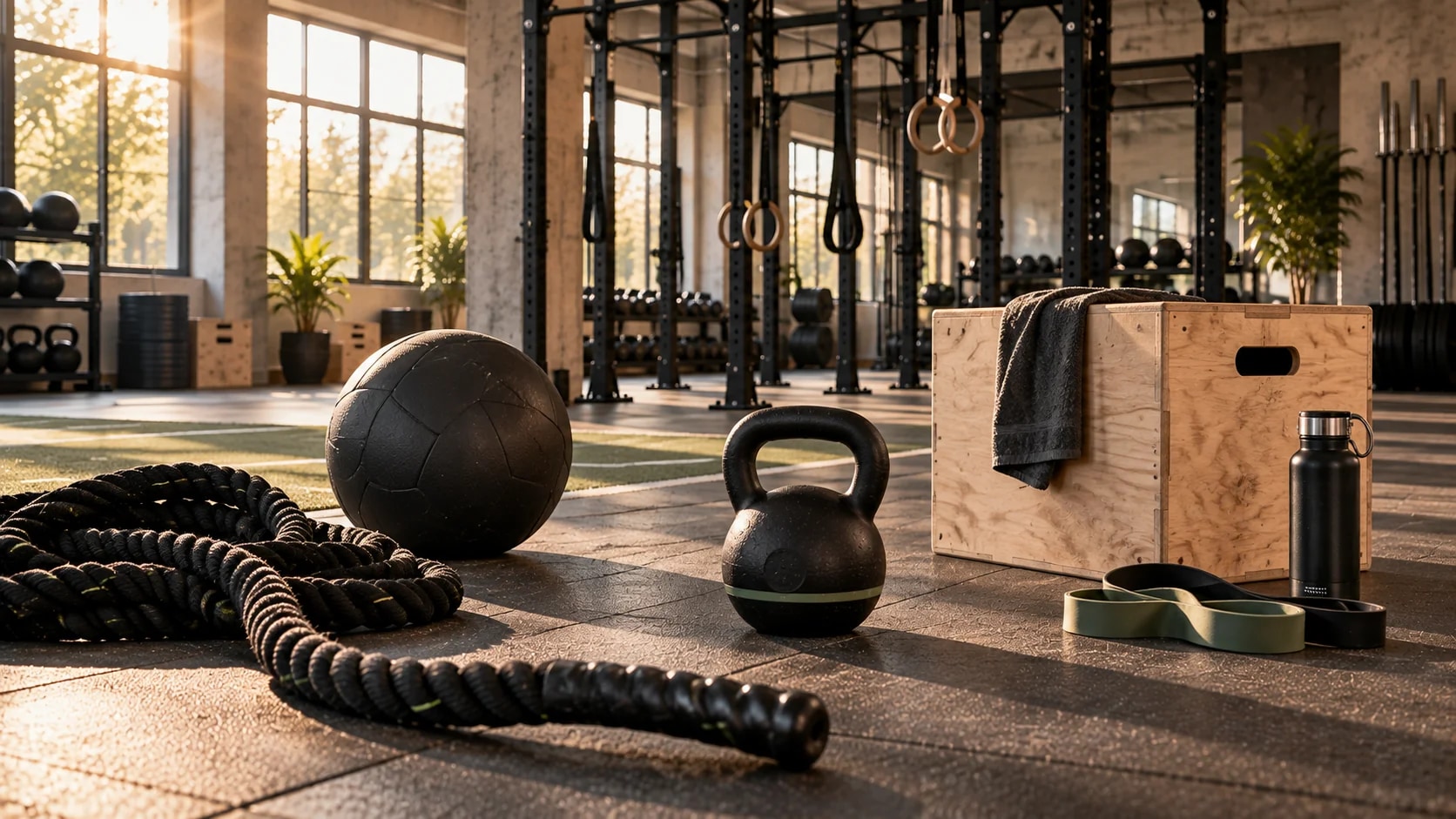
The usual functional training equipment at a glance: resistance bands and tubes for joint-friendly muscle building and pulling exercises, kettlebells for swinging and lifting patterns such as the swing, suspension trainers for pulling and pushing exercises with your own body weight at any intensity, medicine balls for throwing and rotation exercises, and balance pads and stability balls for balance and the deep muscles. Gyms add plyo boxes, battle ropes and free dumbbells to that.
This very independence from equipment is what makes functional training so flexible: it works in the gym, in the park, in the living room and in a hotel room, and your coach can move the training to wherever you happen to be.
Who is functional training for?
Generally for all ages and performance levels, from beginner to athlete, provided the program is adapted to your starting point. This very adaptability is the real strength of the concept.
Four groups benefit especially: people with office jobs who sit a lot and whose core and postural muscles need a counterbalance (matching sessions are in the guide to back pain exercises); athletes who want to practice their discipline with more resilience and resistance to injury, which is exactly what the concept is built for; beginners and returners, because training starts with your own body weight and scales in the smallest steps; and older trainees, because balance, coordination and everyday strength are exactly the abilities that decide independence in old age.
An honest note on safety: if you have existing complaints, after injuries or after a longer break from training, get a check-up with your doctor before you start and be supervised by a qualified coach who adapts the choice of exercises to your situation. Functional training is scalable enough for almost any starting point, but the scaling should be done by someone who knows how.
The right coach for your level
Whether you’re starting out, returning or going for a performance goal: compare verified coaches and request a trial session.
Find a coach nowWhat does a sample workout look like?
A complete beginner workout takes about 30 minutes and needs only your body weight plus a resistance band. It covers all the basic patterns and can be progressed as far as you like through repetitions and tempo.
Warm-up (5 minutes): easy full-body movement, arm circles, jumping jacks, a few slow, deep squats.
Main part as a circuit, 3 rounds with 60 to 90 seconds of rest between rounds:
| Exercise | Repetitions or duration |
|---|---|
| Squats | 12 repetitions |
| Push-ups (on an elevated surface if needed) | 8 to 10 repetitions |
| Lunges | 10 per side |
| Resistance band rows | 12 repetitions |
| Floor hip thrusts | 15 repetitions |
| Plank (forearm plank) | 30 seconds |
Cool-down (5 minutes): easy stretching of the hamstrings, hips and chest.
Progression over the weeks: first more repetitions, then a slower tempo in the lowering phase, then harder variations (deeper squat, feet elevated for the push-up, added weight). If you stick with the workout three times a week for a month, you’ll have the foundation a coach can build on in a targeted way. If you’d rather be coached from home, the guide Online Personal Training puts that option into context.
Frequently asked questions about functional training
How often per week should I do functional training?
For beginners, 2 to 3 full-body sessions per week are ideal, with at least one rest day in between. More brings no extra benefit at the start, because progress happens during the recovery between sessions.
Can I lose weight with functional training?
Because of the full-body load, functional training burns a good amount of energy and preserves muscle while you lose weight. What decides weight loss, though, remains the calorie deficit, meaning nutrition. More on that in the guide to weight loss.
Is functional training suitable for beginners?
Yes, and it’s especially well suited, because every exercise starts with your own body weight and scales in small steps. The order matters: technique first, then intensity. The first sessions with a coach speed up exactly this step.
What’s the difference from CrossFit?
CrossFit is a trademarked competitive training format that combines functional exercises with high intensity and time pressure. Functional training is the broader training approach behind it, without a competitive character and freely scalable, which makes it the gentler starting point for beginners.
How much does functional training with a coach cost?
In one-on-one personal training, the usual rates of €60 to €150 per hour apply; small-group formats start at €12 to €25 per person and session. The complete price overview is in the guide to personal trainer costs.
What equipment do I need at home?
None to start; your body weight is enough. As a sensible addition, a resistance band and a kettlebell are all you need: with them you cover all seven basic patterns and have room to progress for months.
Find, book and pay for a coach in one app
Verified coaches in Berlin and Hamburg, transparent prices, sessions booked right in the app.
View coachesThis guide does not replace individual training advice: if you have complaints, pre-existing conditions or a longer break behind you, start under supervision. You can find, compare and book verified coaches for functional training and personal training in the nucoach app, for Berlin and Hamburg.