
Boxing Training for Beginners: Benefits, Exercises and How to Get Started
Contents
What is boxing training?
Boxing training is the umbrella term for training with boxing techniques, and in most fitness formats you’re not facing an opponent but a punching bag, focus mitts or your own reflection. Fighting and physical contact are optional and stay reserved for traditional club and competitive boxing.
The four common formats at a glance: Fitness boxing is the non-contact workout format that combines boxing techniques with conditioning and strength elements, usually in classes or small groups. Punching bag training applies the techniques against the bag and builds punching power and conditioning. Mitt training is the one-on-one format with a coach: your coach holds the pads, calls out combinations and corrects every movement in real time, making it the most intense and most instructive variant. And traditional boxing at a club or boxing gym leads, through technique and partner drills, toward sparring in the long run, but even there it’s always voluntary.
What this means for you: you can box for years without ever taking a punch. The question isn’t whether to box, but which format fits your goal.
What are the benefits of boxing training?
The core benefits: maximum energy expenditure, full-body strength, coordination and a counterbalance to mentally demanding everyday life. Boxing works on the interval principle (intense rounds, short breaks) and is therefore one of the most effective forms of training for fat burning.
| Benefit | What’s behind it |
|---|---|
| High calorie burn | Depending on intensity and body weight, 400 to 800 kcal per hour; beginners realistically start at 300 to 500. The interval structure adds an afterburn effect, so your metabolism stays elevated after the workout, too. What really works here is explained in the guide Boost Your Metabolism. |
| Full-body workout | Every punch starts in the legs, travels through the core via hip rotation and only ends in the fist. Legs, glutes, core, shoulders and arms work together in every combination, which makes boxing applied functional training. The basics are explained in the guide to Functional Training. |
| Coordination and reaction | Footwork, guard, combinations and evasive movements train the interplay of eyes, nerves and muscles like hardly any other form of training. |
| Clear head | When you’re concentrating on combinations, you can’t think about your inbox at the same time. That’s why many people find boxing training to be the most effective counterbalance to their working day. |
As with any workout, when it comes to weight loss, the calorie deficit is what ultimately decides, and boxing simply makes that deficit much easier to reach, as the guide Weight Loss shows in detail.
Which basic techniques do you learn first?
You start with the basic stance, four basic punches and footwork. You’ll learn this foundation in the first 4 to 6 sessions, and it supports everything that comes after.
| Technique | What it is | What it trains |
|---|---|---|
| Basic stance | Stable starting position with your guard up | Balance, body tension |
| Jab | Quick straight punch with your lead hand | Speed, sense of distance |
| Cross | Powerful straight punch with your rear hand | Hip rotation, punching power |
| Hook | Sideways punch thrown from a rotation | Core rotation, lateral chain |
| Uppercut | Punch from below, driven by the legs | Leg strength, extension |
| Footwork | Steps, changes of direction, distance | Endurance, coordination, calves |
The most important tip for beginners: punching power comes from technique, not from the arm. A clean cross driven by the legs and hips is stronger and easier on the joints than any arm punch thrown with brute force. That’s exactly why a coach is worth it at the start, one who builds the rotation correctly from the very first session, because faulty punching patterns that become ingrained put stress on your shoulders and wrists.
Find a boxing coach in your city
Mitt training, fitness boxing or technique from the ground up: in the nucoach app, you compare verified boxing coaches by format and price and book directly, for boxing in Berlin and boxing in Hamburg.
What does a typical training session look like?
Boxing training follows the round principle: 3 minutes of work, 1 minute of rest, just like in the ring. A complete session lasts 45 to 60 minutes and has a fixed structure that repeats in almost every gym and every personal training session.
Here’s how a typical hour goes: warm-up with a jump rope and mobility work (10 minutes), then technique work and shadowboxing, meaning punch combinations without equipment in front of a mirror (10 to 15 minutes), followed by the main part with 3 to 5 rounds on the punching bag or with the mitts (15 to 20 minutes), then core and strength exercises such as planks, sit-up variations and push-ups (10 minutes), and finally an easy cool-down and stretching (5 minutes). If you want to build up the strength portion systematically, the guide Strength Training for Beginners has the right full-body plan.
The round principle is also the reason boxing is so effective: alternating between intense effort and short rest drives your heart rate and energy expenditure up. It’s classic interval training, just with far more variety than on a treadmill.
Do you need sparring?
No. In a fitness context, sparring is completely optional and isn’t even planned in most formats. Fitness boxing, punching bag and mitt training are entirely non-contact; the worst you’ll get there is sore muscles.
Putting it in context: sparring, meaning the controlled practice bout with a partner, belongs to traditional competitive boxing, and even there it’s only introduced after months of solid technique training, with protective gear and under supervision. If the athletic side ever tempts you, the right path is through a boxing gym with experienced trainers. If you use boxing as a fitness format, you simply never come across it, and that’s exactly what makes boxing training so accessible for beginners: the intensity of a martial art without its risk.
What equipment do you need?
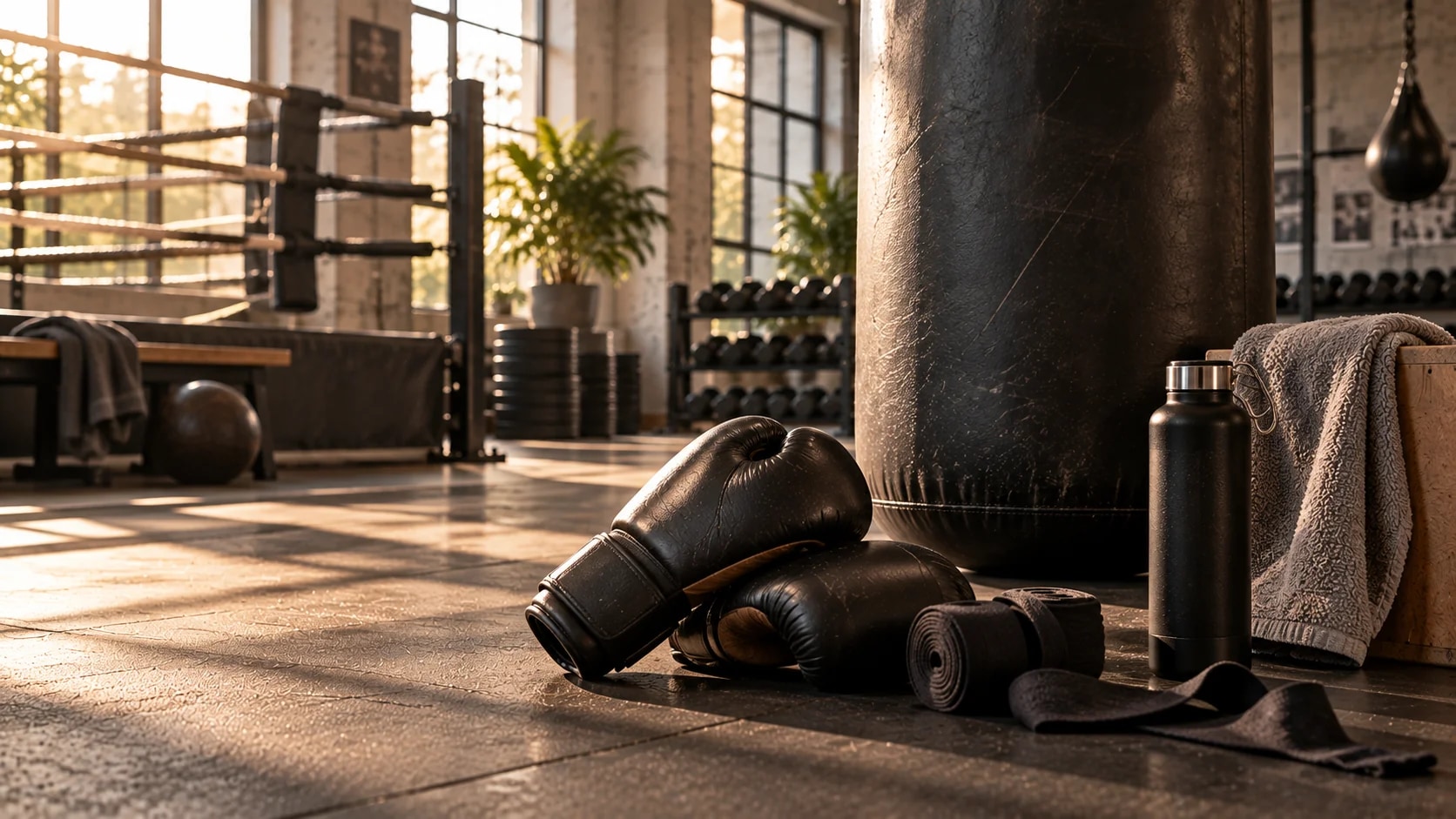
To get started, all you need are hand wraps and a pair of boxing gloves, which together are a manageable purchase, and many studios and personal training sessions even provide the equipment.
The basics in detail: Hand wraps stabilize your wrists and knuckles and go under every glove; they’re the most important and cheapest part of your gear. Boxing gloves are measured in ounces (oz): for training on the bag and with mitts, 12 to 16 oz is common, and heavier gloves pad more and protect your hands; your coach will advise you on the choice. A jump rope is a perfect addition to home training, as it’s the classic warm-up and conditioning tool in boxing. You only need your own punching bag once you want to train at home regularly.
Important before your first purchase: train 2 to 3 sessions with borrowed or rented equipment first, then buy. That way you’ll know which format you want to pursue and which glove size suits you.
Who is boxing training suitable for?
For far more people than the martial arts image suggests: fitness boxing is freely scalable and works for beginners, people returning to training and advanced athletes of any age, and the share of women in classes has been growing for years.
You control the intensity yourself through pace, rest and number of rounds, and a good coach adapts every session to your level. People who benefit especially are those who find classic endurance training boring (boxing is interval training that engages your head), people who sit a lot and want to train rotation and posture, and everyone looking for a mental counterbalance where everyday life stays outside.
An honest safety note: if you have existing shoulder, wrist or back problems, get checked by a doctor before you start, and your first sessions should always be guided so that no stressful punching patterns become ingrained. How to recognize a qualified coach is covered in the guide Find a Personal Trainer.
Boxing training with a coach or on your own?
The clear recommendation for getting started: do your first 5 to 10 sessions with a coach, then feel free to combine. Boxing is more technically demanding than it looks, and the fundamentals determine results and joint health.
Your options compared: one-on-one mitt training with a personal trainer is the fastest learning curve, with prices in line with the usual personal training market of €60 to €150 per hour, and you’ll find all the details in the guide to Personal Trainer Costs. Classes and small groups at a boxing gym or studio are the cheaper entry point with group dynamics. And solo training on the bag or via shadowboxing is the perfect supplement between coached sessions, once your technique is solid.
The combination model that works best for most people: one coached session per week (coach or class) plus one to two solo sessions. That way your technique keeps growing while conditioning and routine develop in your own training. How to spread coached and solo sessions sensibly across the week is shown in the guide Create a Training Plan. If you’re interested in other disciplines besides boxing, the guide Martial Arts gives you the complete overview.
Book a trial session directly
Verified coaches for boxing training and fitness boxing, with transparent prices in every profile.
Find a coach nowFrequently asked questions about boxing training
How many calories does boxing training burn?
Depending on intensity and body weight, about 400 to 800 kcal per hour; beginners realistically start at 300 to 500. The interval structure adds an afterburn effect, so your energy expenditure stays elevated after the workout.
Can I start without any experience?
Yes, fitness boxing and mitt training are explicitly beginner-friendly, and you’ll learn the basic techniques in the first 4 to 6 sessions. The only thing that matters is that your first sessions are guided, so your punching technique is clean from the start.
How often per week should I box?
Two to three sessions per week are ideal for most people, with at least one rest day in between. Boxing is intense interval training, and recovery between sessions is part of your progress.
Will I get bruises from boxing training?
Not with fitness boxing, punching bag or mitt training; these formats are completely non-contact. Physical contact only happens in voluntary sparring in traditional boxing, and even there only after months of technique training and with protective gear.
How much does boxing training cost?
Classes and small groups start at about €12 to €25 per session, and one-on-one training with a boxing coach falls within the usual personal training range of €60 to €150 per hour. Your own basic equipment (hand wraps plus gloves) is a one-time, manageable purchase.
Is boxing training good for weight loss?
Yes, thanks to its interval principle, boxing is one of the most effective forms of training for creating a large calorie deficit. Nutrition still decides, though: training raises your energy burn, and the deficit is created at the dinner table.
Find, book and pay your coach in one app
Verified coaches in Berlin and Hamburg, transparent prices, and booking directly in the app.
View coachesThis guide does not replace individual training advice: if you have health issues or are coming back after a longer break, your start belongs in guided hands. You can find, compare and book verified boxing coaches in the nucoach app, for Berlin and Hamburg.