
High-Protein Foods: The Top Protein Sources in a Table
Contents
- What are high-protein foods?
- How much protein do you need per day?
- Table: Animal foods with a lot of protein
- Table: Plant-based and vegan protein sources
- Which food has the most protein?
- High-protein foods for weight loss
- Protein for building muscle
- Combining vegan and vegetarian protein sources the right way
- Sample day plan with about 130 g of protein
- Do you need protein powder?
- Myths and mistakes about protein
- Nutrition with a coach: when is counseling worth it?
- Frequently asked questions
What are high-protein foods?
High-protein foods provide a particularly large amount of protein relative to their weight or their calories. As a rough guide, foods with about 10 g of protein or more per 100 g count as high in protein, and the best sources provide 20 g or more. The word protein comes from Greek and means roughly “the first” or “the most important.”
There are fixed rules in the EU for food packaging. A product may be advertised as a source of protein if at least 12% of its energy content comes from protein. The claim “high protein” is allowed at 20% or more. These rules explain why yogurts, bars, and breads labeled “protein” have become so common in supermarkets. Still, it is worth a look at the nutrition facts table, because some of these products contain more protein, but also a lot of sugar or fat.
In the body, protein is the most important building material. Muscles, skin, hair, enzymes, hormones, and antibodies consist largely of it. Protein is made up of 20 amino acids, 9 of which are essential, which means the body cannot make them itself and has to take them in through food. Animal foods contain all the essential amino acids in a ratio very close to human needs. Plant sources often have less of individual amino acids, which can be balanced out well by combining foods.
Protein is also the nutrient that fills you up the most. In addition, the body uses much more energy to digest protein than to digest carbohydrates or fat: Around 20 to 30% of the calories from protein are lost during processing, compared with about 5 to 10% for carbohydrates and only a few percent for fat. Both facts explain why a high-protein diet is so helpful for weight loss.
How much protein do you need per day?
The German Nutrition Society recommends 0.8 g of protein per kilogram of body weight per day for adults up to age 65 and 1.0 g from age 65. If you want to build muscle, or hold on to it while losing weight, 1.6 to 2.2 g per kilogram is a workable range. The table shows the values for different goals, with an example for a body weight of 70 kg.
| Goal or life stage | Protein per kg of body weight | Example: 70 kg |
|---|---|---|
| Adults up to age 65, not training | 0.8 g | 56 g per day |
| Adults age 65 and older | 1.0 g | 70 g per day |
| Building muscle with strength training | 1.6 to 2.2 g | 112 to 154 g per day |
| Losing weight while keeping muscle | 1.6 to 2.2 g | 112 to 154 g per day |
You calculate your own protein needs like this: body weight in kilograms times the factor for your goal. A person weighing 80 kg who wants to build muscle comes to 128 to 176 g of protein a day at 1.6 to 2.2 g per kilogram. For people with significant excess weight, the requirement is usually calculated using the target weight or an adjusted weight, because fat tissue needs hardly any protein. Nutrition counseling can determine the exact value for you.
The society’s 0.8 g figure describes the amount that protects almost all healthy adults from a deficiency. For people who do strength training regularly or want to hold on to muscle during a diet phase, studies show better results with higher amounts. How protein, calories, and timing work together when you build muscle is explained in the guide Muscle Building Nutrition: Protein, Calories and Timing.
From around age 65, protein needs go up, which is why the recommendation there is 1.0 g per kilogram. With age, muscle mass declines steadily without countermeasures, and the muscles respond less strongly to protein from food. Enough protein and regular strength training are the two most effective ways to preserve strength, balance, and independence in old age. Older people often eat less, though, because appetite and the feeling of hunger fade. Small, high-protein snacks such as quark, yogurt, cheese, or an egg help them reach their daily amount anyway.
Table: Animal foods with a lot of protein
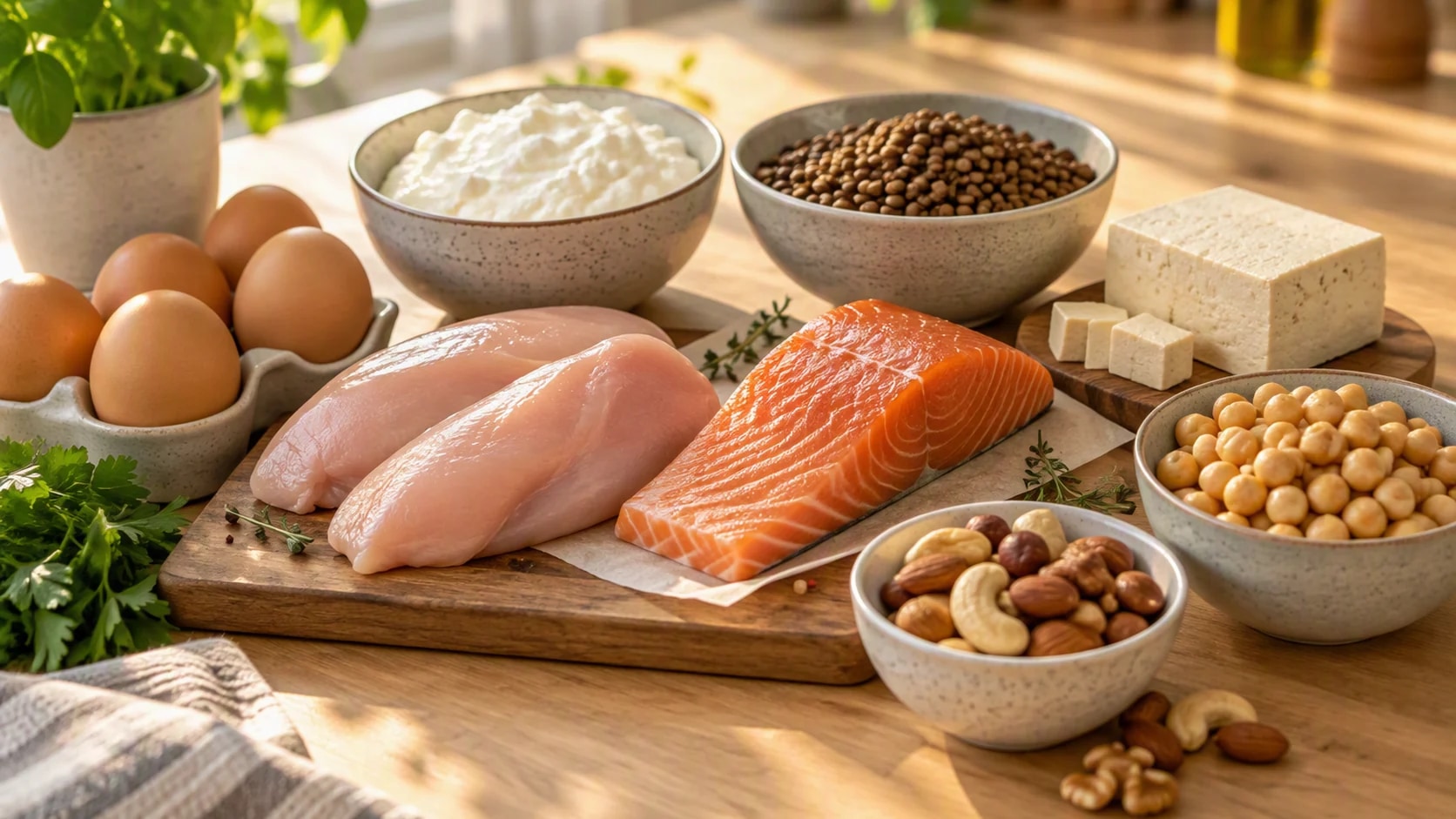
Animal foods with the most protein per 100 g are Parmesan, Harzer cheese, tuna, Gouda, turkey breast, and chicken breast. Turkey breast, chicken breast, pollock, shrimp, low-fat quark, and skyr stand out with very few calories. All values are averages for the raw or ready-to-eat food and can vary from product to product.
| Food | Protein per 100 g | Calories per 100 g |
|---|---|---|
| Parmesan | 33 g | 390 kcal |
| Harzer cheese | 28 g | 120 kcal |
| Canned tuna in water (drained) | 25 g | 110 kcal |
| Gouda (45% fat in dry matter) | 25 g | 350 kcal |
| Turkey breast (raw) | 24 g | 105 kcal |
| Chicken breast (raw) | 23 g | 105 kcal |
| Beef rump (raw) | 22 g | 115 kcal |
| Salmon (raw) | 20 g | 200 kcal |
| Shrimp (raw) | 19 g | 85 kcal |
| Pollock (raw) | 18 g | 80 kcal |
| Chicken egg (whole egg, about 2 eggs) | 13 g | 145 kcal |
| Low-fat quark | 12 g | 70 kcal |
| Cottage cheese | 12 g | 95 kcal |
| Skyr | 11 g | 65 kcal |
| Egg whites | 11 g | 50 kcal |
| Milk (1.5% fat) | 3.4 g | 47 kcal |
For meat and fish, the values refer to raw weight. When meat is cooked, it loses water, so the protein content per 100 g goes up: Cooked chicken breast comes in at about 30 g of protein per 100 g, even though not a single gram of protein has been added. If you count your protein precisely, it is therefore best to weigh food raw, or to use the matching values for the cooked state when you weigh cooked food.
Dairy products are especially practical because they are inexpensive, need no preparation, and work in both sweet and savory dishes. Low-fat quark (a fresh dairy product similar to thick Greek yogurt) and skyr provide a lot of protein for few calories, and Harzer cheese (a German sour-milk cheese) has almost no fat, which makes it one of the highest-protein cheeses there is. Firm cheeses such as Parmesan and Gouda do contain a lot of protein, but also a lot of fat, so they work better as an addition in small amounts.
Eggs used to be considered unhealthy because the yolk contains a lot of cholesterol. Today, professional societies take a much more relaxed view: In most healthy people, cholesterol from food affects blood cholesterol levels less than people long assumed. Several eggs per week fit well into a balanced diet. If you have elevated blood lipid levels, talk to your doctor about how many eggs are right for you. Egg whites on their own are almost fat-free and, with about 11 g of protein per 100 g at only 50 kcal, are one of the leanest protein sources there is.
Table: Plant-based and vegan protein sources
The best vegan protein sources are soybeans, pumpkin seeds, hemp seeds, seitan, lentils, peanuts, tempeh, and tofu. Legumes, seeds, and soy products also provide fiber, which animal foods do not contain. The values apply to the dried or ready-to-eat food, as listed.
| Food | Protein per 100 g | Calories per 100 g |
|---|---|---|
| Soybeans (dried) | 36 g | 440 kcal |
| Hemp seeds (hulled) | 31 g | 580 kcal |
| Pumpkin seeds | 30 g | 580 kcal |
| Seitan (ready to eat) | 25 g | 140 kcal |
| Peanuts | 25 g | 590 kcal |
| Red lentils (dried) | 24 g | 330 kcal |
| Almonds | 21 g | 600 kcal |
| Chickpeas (dried) | 19 g | 360 kcal |
| Tempeh | 19 g | 190 kcal |
| Plain tofu | 15 g | 140 kcal |
| Quinoa (dried) | 14 g | 360 kcal |
| Rolled oats | 13 g | 370 kcal |
| Edamame (shelled) | 11 g | 125 kcal |
| Lentils (cooked) | 9 g | 115 kcal |
With legumes, it pays to check which state the numbers refer to. Dried lentils provide 24 g of protein per 100 g, but cooked they have only about 9 g, because they soak up a lot of water as they cook. A 60 g portion of dried lentils makes about 150 g of cooked lentils and about 14 g of protein. Canned chickpeas and beans are in a similar range to cooked lentils.
Nuts and seeds are high in protein but also very energy-dense. A handful of about 30 g of pumpkin seeds provides about 9 g of protein and about 175 kcal. As a topping on salad, yogurt, or porridge, they are a good addition; as a main protein source, tofu, tempeh, seitan, and legumes are better suited.
There is a persistent worry about soy and plant estrogens, the so-called isoflavones. By current knowledge, usual amounts of soy foods such as tofu, tempeh, edamame, or soy milk are considered safe for healthy adults. Caution is more appropriate with high-dose isoflavone supplements. Seitan is made of wheat protein (gluten) and is therefore unsuitable for people with celiac disease or gluten intolerance. For them, soy, legumes, quinoa, and seeds are the better choice.
Which food has the most protein?
Per 100 g, protein powder with about 75 to 80 g, dried soybeans with 36 g, and Parmesan with 33 g lead the field. Relative to calories, Harzer cheese, turkey breast, tuna, pollock, and shrimp win with more than 22 g of protein per 100 kcal. In practice, the value per 100 kcal is often more telling, because it shows how much protein you get for a given share of your calorie budget.
| Rank | Food | Protein per 100 kcal |
|---|---|---|
| 1 | Harzer cheese | 23.3 g |
| 2 | Turkey breast | 22.9 g |
| 3 | Canned tuna in water | 22.7 g |
| 4 | Pollock | 22.5 g |
| 5 | Shrimp | 22.4 g |
| 6 | Egg whites | 22.0 g |
| 7 | Chicken breast | 21.9 g |
| 8 | Whey protein powder (about 78 g protein, 380 kcal per 100 g) | 20.5 g |
| 9 | Beef rump | 19.1 g |
| 10 | Seitan | 17.9 g |
| 11 | Low-fat quark | 17.1 g |
| 12 | Skyr | 16.9 g |
The ranking shows why soybeans, Parmesan, and pumpkin seeds are not the first choice for weight loss despite their high protein content per 100 g: They bring a lot of fat and therefore a lot of calories. For Parmesan it is about 8.5 g of protein per 100 kcal, for pumpkin seeds only about 5 g. Tofu and tempeh sit in the middle with about 10 to 11 g, but also provide fiber and healthy fats.
For everyday life, a simple rule of thumb is enough: Lean meat, fish, egg whites, and low-fat dairy products give you the most protein per calorie. Eggs, salmon, tofu, and legumes give you a little less protein per calorie, but bring valuable fats, vitamins, or fiber. A good diet combines both.
High-protein foods for weight loss
For weight loss, foods with a lot of protein and few calories work best: turkey breast, chicken breast, pollock, canned tuna in water, shrimp, low-fat quark, skyr, Harzer cheese, egg whites, tofu, and lentils. Protein helps with weight loss in 3 ways: It is very filling, it costs a lot of energy to digest, and it protects your muscles in a calorie deficit.
The third point is often underestimated. Without enough protein and strength training, people who lose weight lose muscle along with fat. Less muscle mass lowers energy expenditure and makes it harder to keep the new weight off. A protein intake of 1.6 to 2.2 g per kilogram of body weight together with 2 to 3 strength sessions per week makes sure that the weight you lose is mostly fat. Whether you lose weight is still decided by the calorie deficit, which you can work out with the guide How to Calculate a Calorie Deficit: Formula, Examples, and Table.
In practice, this works best when every meal starts with a clear protein source. For breakfast, low-fat quark or skyr instead of sweet pastries; at lunch, a portion of lean meat, fish, or tofu with vegetables; at dinner, eggs, cottage cheese, or lentils. If you also use intermittent fasting, put the protein into the remaining meals so that the daily amount still adds up, as the guide Intermittent Fasting: Methods, 16:8 Plan, and Benefits shows. The overall concept of deficit, protein, and training is covered in the guide Weight Loss: What Really Works and What Doesn’t.
This is easiest with meals cooked ahead for several days. A weekly plan, how long food keeps in the fridge, and high-protein recipes are covered in the guide Meal Prep for Beginners.
A common misconception concerns metabolism. Protein does measurably increase energy expenditure during digestion, but the effect amounts to a few dozen kilocalories a day and does not replace a deficit. Which measures really influence your metabolism is explained in the guide Boost Your Metabolism: What Works and What’s Just a Myth.
A nutrition plan with enough protein, built around your daily life
Nutrition counseling works out your needs and builds a plan with foods you actually like. In the nucoach app, you compare verified nutrition coaches by qualifications and price and book directly, for nutrition coaching in Berlin and nutrition coaching in Hamburg.
Protein for building muscle
For building muscle, 1.6 to 2.2 g of protein per kilogram of body weight per day makes sense, spread across 3 to 4 meals of 20 to 40 g each. Without strength training, though, even a lot of protein does not build muscle. Protein is the raw material, and training is what tells the body to use it.
How you spread protein across the day matters more than the exact timing after training. After every high-protein meal, the body builds muscle protein at an increased rate for several hours. If you spread your daily amount across several meals with enough protein each, you use this effect several times. A breakfast with only 5 g of protein and a dinner with 80 g is therefore less favorable than 4 meals with 30 to 35 g each.
The famous window right after training is smaller than it is often made out to be. If you eat a high-protein meal 2 to 3 hours before or after training, you are well supplied. For older people, a somewhat larger amount of protein per meal makes sense, because muscles respond less strongly to protein with age. How to set the right training stimuli is shown in the guide Strength Training for Beginners: Plan, Exercises and Getting Started.
Foods with a lot of leucine, an amino acid that kicks off muscle building, are particularly valuable for building muscle. Dairy products, meat, fish, eggs, and soy contain a lot of leucine. Plant sources often have somewhat less, which can be balanced out with slightly larger portions or combinations.
Combining vegan and vegetarian protein sources the right way
Vegan and vegetarian diets cover protein needs well when different protein sources are combined over the course of the day, especially legumes with grains, nuts, or seeds. Soy, tofu, tempeh, and seitan provide particularly large amounts of protein per serving. The combination does not have to happen in every meal; it is enough if it adds up over the day.
The reason lies in biological value. It describes how well the body can convert a dietary protein into its own protein. Legumes have little of the amino acid methionine but a lot of lysine; grains are exactly the other way around. Together they complement each other into a high-quality protein. Classic combinations are lentils with rice, beans with corn, hummus with whole-grain bread, or oats with soy milk. Animal and plant sources also complement each other well: Potatoes with egg have been considered an example of a particularly high-quality combination for decades.
For vegans, it is advisable to aim for the upper end of the protein range, because plant protein is, on average, somewhat less digestible. If you want to build muscle, plan one portion of tofu, tempeh, seitan, or legumes per main meal and add a plant-based protein powder made from pea, soy, or rice as needed. Vegetarians have an easier time meeting their needs with eggs, quark, skyr, and cheese.
Sample day plan with about 130 g of protein
This day plan provides about 130 g of protein from regular foods without protein powder, spread across 4 meals. That works out to about 1.8 g per kilogram for a person weighing 70 kg. The amounts can be adjusted as needed; the protein values are rounded.
| Meal | Foods | Protein |
|---|---|---|
| Breakfast | 250 g low-fat quark, 50 g rolled oats, a handful of berries | about 37 g |
| Lunch | 150 g chicken breast (weighed raw), 70 g rice (weighed raw), 200 g vegetables | about 43 g |
| Snack | 150 g skyr, 15 g almonds | about 20 g |
| Dinner | 2 eggs, 100 g whole-grain bread, 100 g cottage cheese, raw vegetables | about 32 g |
| Total | 4 meals | about 132 g |
For a vegetarian version, you replace the chicken breast with 200 g of tofu or 75 g of dried lentils plus some feta. For a vegan version, low-fat quark and skyr are swapped for high-protein soy yogurt, the eggs and cottage cheese for tofu scramble with hummus, and hemp seeds or pumpkin seeds are added as a topping over the course of the day. The protein content of vegan yogurt alternatives varies a lot, so it pays to check the package.
If you have little time in everyday life, you can work with a few staple ingredients: Low-fat quark, skyr, eggs, tuna, tofu, canned lentils, and oats keep for a long time or are quick to prepare and cover most of your needs. More practical strategies for daily life are shown in the guide Weight Loss Tips: 12 Strategies That Work in Daily Life.
Eating high in protein does not have to be expensive. Among the cheapest protein sources per gram of protein are dried lentils, chickpeas, and beans, low-fat quark, oats, eggs, and tofu from the supermarket shelf. Fish, shrimp, beef, and special protein products with “protein” printed on the package cost more. If you make the inexpensive staples your base and add pricier sources selectively, you can easily reach 120 to 150 g of protein a day on a normal grocery budget. Larger packs and frozen items like chicken breast, pollock, or edamame lower the cost further.
Do you need protein powder?
Protein powder is not a must; you can meet your protein needs with regular foods. But it is a practical supplement when time is short, your needs are high, or you lack a quick protein source on the go. A shake with 30 g of powder provides about 22 to 25 g of protein, depending on the product.
The most common types are whey protein (from milk whey), which is absorbed quickly; casein (from milk), which is digested more slowly; and plant-based powders made from pea, soy, rice, or blends of these. Plant-based blends of pea and rice complement each other in their amino acids much like legumes and grains. When buying, look for a high protein content per serving, little sugar, and a short ingredient list.
What matters is keeping it in perspective: Protein powder does not replace a meal with vegetables, fiber, and micronutrients. It is a tool for gaps in your daily plan, for example after training when you won’t eat for hours, or as the base for a quick breakfast with oats and fruit.
Myths and mistakes about protein
The most common myths concern the kidneys, the supposedly limited absorption per meal, the assumption that more protein automatically means more muscle, and the supposed inferiority of plant protein sources. The table sets the most important misconceptions straight.
| Myth or mistake | What’s true |
|---|---|
| Lots of protein harms the kidneys | For healthy people, amounts up to about 2 g per kg are considered safe by current knowledge. With existing kidney disease, the amount is set by a doctor. |
| The body can only use 30 g per meal | The body also absorbs larger amounts; they are just processed more slowly. Spreading protein across several meals still makes sense. |
| More protein means more muscle | Above about 2.2 g per kg, extra protein brings hardly any further benefit. The training stimulus is what matters. |
| Plant protein is inferior | Combined over the day, plant sources provide all essential amino acids. Soy on its own already has a high biological value. |
| Protein bars are healthy | Besides protein, many bars contain a lot of sugar, fat, or sweeteners. Check the nutrition facts table and think of bars more as a snack for on the go. |
| Protein only matters after training | Total amount and distribution across the day count more than the exact timing after the session. |
One mistake that happens often in practice is a low-protein breakfast. Rolls with jam, muesli with milk, or just coffee often provide less than 10 g of protein. It is hard to make that up over the rest of the day without eating very large portions in the evening. If you bring your breakfast to 25 to 35 g of protein, for example with low-fat quark, skyr, eggs, or tofu, you have already done the hardest part of the day.
A second mistake involves special high-protein products. Pudding, bread, pasta, or ice cream with “protein” printed on the package often cost many times as much as the regular version, yet do not necessarily deliver more protein than a tub of low-fat quark or skyr. Comparing the nutrition facts tables quickly shows whether the extra price is worth it. For most people, regular high-protein foods are the better and cheaper base, and special products remain a supplement for particular situations.
Nutrition with a coach: when is counseling worth it?
Nutrition counseling is worth it when you want to know your exact protein needs, are pursuing a specific goal such as weight loss or muscle building, or need to take pre-existing conditions, intolerances, or a vegan diet into account. In Berlin and Hamburg, the initial consultation usually costs €80 to €120 and follow-up sessions cost €50 to €100. Online sessions often cost €40 to €90, and certified counseling is subsidized by many statutory health insurers.
Good counseling does more than calculate numbers. It builds a plan from foods that fit your taste, your budget, and your daily life, and adjusts it in follow-up sessions. What counseling costs and how to get the health insurance subsidy is covered in the guide Nutrition Counseling Costs 2026: Prices and Health Insurance Subsidies. How nutrition counseling and nutrition coaching differ is explained in the guide Nutrition Coach: What They Do, Qualifications, and When It Pays Off.
You can find verified nutrition coaches in the nucoach app, for nutrition coaching in Berlin and nutrition coaching in Hamburg. Many coaches offer combined packages of training and nutrition that are especially well suited to goals such as building muscle or losing weight while keeping muscle.
Book a nutrition coach directly
Verified nutrition coaches with transparent prices in every profile, on site or online.
Find a coach nowFrequently asked questions about high-protein foods
Which food has the most protein?
Per 100 g, protein powder with roughly 75 to 80 g, dried soybeans with roughly 36 g, Parmesan with roughly 33 g, and pumpkin seeds with roughly 30 g provide the most protein. Relative to calories, Harzer cheese, turkey breast, tuna, pollock, shrimp, and chicken breast come out on top.
How much protein do you need per day?
The German Nutrition Society recommends 0.8 g of protein per kilogram of body weight for adults up to age 65 and 1.0 g from age 65. If you want to build muscle, or hold on to it while losing weight, 1.6 to 2.2 g per kilogram is a workable range.
Which foods are high in protein and low in calories?
Lean meats and fish such as turkey breast, chicken breast, pollock, and canned tuna in water, plus shrimp, egg whites, low-fat quark, skyr, and Harzer cheese. They provide roughly 17 to 23 g of protein per 100 kcal, which makes them ideal for weight loss.
What are good vegan protein sources?
Tofu, tempeh, seitan, soybeans, edamame, lentils, chickpeas, beans, pumpkin seeds, hemp seeds, and oats. If you combine different plant sources over the course of the day, for example legumes with grains, you cover all the essential amino acids well.
Is too much protein harmful?
For healthy adults, protein intakes of up to about 2 g per kilogram of body weight are considered safe by current knowledge. If you have kidney disease, talk to your doctor about how much protein is right for you. Enough fluids and a balanced diet with vegetables and fiber matter too.
Do you need protein powder?
No. You can cover your protein needs with regular foods. Protein powder is a convenient supplement when time is short, your needs are very high, or you lack a quick protein source on the go.
How much protein should a meal contain?
For most adults, 20 to 40 g of protein per main meal makes sense, spread across 3 to 4 meals a day. This distribution supports muscle building better than one single very high-protein meal and keeps you feeling full throughout the day.
Find, book and pay your coach in one app
Verified nutrition coaches in Berlin and Hamburg, transparent prices, booking directly in the app.
View coachesThe nutritional values are averages and may vary depending on the product, variety, and preparation. This guide is for general information and does not replace medical or nutrition therapy advice. In cases of kidney disease, metabolic disorders, intolerances, or pregnancy, nutrition belongs under professional guidance. You can find, compare, and book verified nutrition coaches in the nucoach app, for Berlin and Hamburg.