
Pilates Exercises: The 10 Most Important Moves to Do at Home, Explained
Contents
What makes Pilates exercises special?
Pilates exercises follow a system that Joseph Pilates developed in the 1920s: controlled, precise movements that all start from the center of the body. That sets them apart from classic fitness exercises, where repetitions and weight take center stage.
The center of the method is the Powerhouse: the corset muscles between the rib cage and pelvis, consisting of the diaphragm, the deep abdominal muscles, the back muscles, and the pelvic floor. These muscles stabilize your spine and posture, but they are chronically underused in a sitting-heavy daily life, which is exactly why Pilates works so specifically against the typical desk-job consequences.
Six principles run through every exercise: Concentration (perform every movement consciously), Control (quality beats quantity), Centering (everything starts from the Powerhouse), Breathing (deep and guided, it activates the deep muscles), Precision (a few exact repetitions instead of many half-hearted ones), and Flow (movements transition smoothly into one another). In practice, that means 8 precise repetitions do more than 20 sloppy ones, and that is exactly how you can recognize good Pilates training.
The 10 most important Pilates exercises with instructions
These 10 exercises cover the complete basic repertoire: Powerhouse activation, abs, back, the lateral chain, and full-body tension. Perform each exercise slowly, with 6 to 10 repetitions, and keep breathing steadily.
| Exercise | How to do it |
|---|---|
| 1. Pilates breathing with Powerhouse activation | Lie on your back with knees bent and feet flat, hands on your lower ribs. Breathe deep into your ribs; as you exhale, gently draw your navel in and activate your pelvic floor inward and upward. This is the activation that supports every other exercise. |
| 2. The Hundred | Lie on your back with your legs lifted and bent, lift your head and shoulders slightly, arms long beside your body. Your arms pump up and down in small, quick movements while you inhale for 5 beats and exhale for 5 beats, until you have counted to 100. |
| 3. Shoulder Bridge | Lie on your back with your feet flat, hip-width apart. As you exhale, lift your pelvis one vertebra at a time until knees, hips, and shoulders form a line, hold briefly at the top, then slowly roll back down. |
| 4. Single Leg Stretch | Lie on your back with your upper body slightly lifted, pull one knee toward your chest and extend the other leg long, alternating. Your torso stays completely still. |
| 5. Criss-Cross | Like Single Leg Stretch, but your upper body also rotates toward the bent knee, elbow toward the opposite knee. Go slowly, without pulling on your head. |
| 6. Roll-Up | Lie on your back with your arms overhead. As you exhale, roll up to sitting one vertebra at a time, reach over your legs, and roll back down just as controlled. No momentum; the control is the exercise. |
| 7. Spine Stretch | Sit upright with your legs open and arms reaching forward. As you exhale, stretch forward with a rounded back, one vertebra at a time, then sit back up. |
| 8. Side Kicks | Lie on your side with your body in one line, and swing the top leg forward and back at hip height with control, without your torso wobbling. |
| 9. Swimming | On all fours with your pelvis neutral. Lift your right arm and left leg at the same time to back height, then switch sides. The advanced variation is done lying on your stomach with alternating arm and leg beats. |
| 10. Leg Pull Front (Pilates Plank) | Support yourself on your hands and toes with your hands directly under your shoulders, body in one line, and neck long. Hold; for more intensity, lift one leg a few centimeters. |
To get the finer points right (pelvic position, breathing rhythm), the first sessions with instruction are worthwhile, because Pilates lives on details that are easy to miss in videos.
Learn Pilates with guidance
The finer points (Powerhouse, breathing, pelvic position) click fastest with a coach. In the nucoach app, you will find verified Pilates trainers in your city: Pilates in Berlin and Pilates in Hamburg.
What mistakes do beginners make most often?
The three classics: holding your breath, momentum instead of control, and shoulders hiked up toward your ears. All three come from the same cause, namely trying to do everything perfectly at the same time from the start.
The solution is staged: first concentrate on clean movement execution and simply let your breathing continue calmly at the beginning; the exact breathing technique will come on its own with time. Deliberately slow down on every exercise, because where momentum does the work, your deep muscles take a break, and they are exactly the muscles you want to train. And check your shoulders from time to time: away from your ears, long and relaxed.
The Pilates plank (leg pull front) builds on the classic forearm plank. Technique, hold times, and variations are covered in the guide How to do a plank correctly.
Two honest notes belong here: first, Pilates is not a weight-loss miracle; your core gets stronger and your posture improves, but body weight is still driven by nutrition, as the guide Weight Loss explains in detail. Second, a special rule applies during pregnancy: intense Powerhouse activation is not appropriate then, so train in this phase only under qualified guidance and after consulting your doctor or midwife.
What does a 20-minute program for home look like?
The complete beginner program needs a mat, 20 minutes, and no equipment. It follows the classic class logic: activate first, then abs, then back and side, and stretch at the end.
| Exercise | Duration |
|---|---|
| Pilates breathing with Powerhouse activation | 2 minutes |
| The Hundred | 1 round |
| Shoulder Bridge | 8 repetitions |
| Single Leg Stretch | 8 per side |
| Criss-Cross | 6 per side |
| Roll-Up | 6 repetitions |
| Swimming (all-fours variation) | 8 per side |
| Side Kicks | 8 per side, then switch sides |
| Spine Stretch | 6 repetitions |
| Finish | 2 minutes of calm breathing lying on your back |
Three sessions per week over 4 to 6 weeks, and you will notice the difference first in everyday life: sitting more upright, a more stable core, moving more consciously. After that, it is the right time to refine and progress the exercises under guidance.
Mat or Reformer: Where do you train better?
For getting started, the answer is clear: mat Pilates first. It needs no equipment, builds the basic technique, and can be done anywhere. The Reformer, the classic Pilates machine with a sliding carriage and spring resistance, is the extension for later.
The Reformer has two strengths: the spring resistance guides and supports movements (which helps especially with limitations) and makes exercises more precisely adjustable in both directions, easier and harder. In return, Reformer training is tied to a studio, a machine, and usually higher class prices. The sensible order for most people: build the basic technique on the mat, then try Reformer classes as a complement if you have the desire and the budget. Doing both is the ultimate combination, and neither replaces the other.
How often should you do Pilates?
The proven frequency: 2 to 3 sessions per week, and feel free to do them as 20-minute programs instead of long classes, because in Pilates regularity beats the length of any single session.
Pilates also combines extremely well with other training: as a stability foundation, it complements strength training and running, and it shares the core principle of movement quality with functional training; the connections are explained in the guide to Functional Training. If you combine both (2 times Pilates, 1 to 2 times strength or functional training per week), you cover stability, strength, and flexibility completely. The right way to get started with strength training is covered in the guide Strength Training for Beginners.
Pilates or yoga: Which is right for you?
The short version: Pilates is a training system focused on core and posture, while yoga combines body work with breathing and relaxation practice. Both work on the mat but pursue different core goals.
If your main goal is a strong center, better posture, and controlled strengthening, the more direct route is Pilates. If, besides flexibility, you also want relaxation, breathwork, and mental balance, yoga is the broader approach; the basics are in the guide Yoga Exercises. Many people combine both and take from each system what they are missing. You can find matching classes and coaches for both directions under Yoga in Berlin and Yoga in Hamburg.
Your coach for Pilates and more
Verified coaches, transparent prices, request a trial session directly.
Find a coach nowFrequently asked questions about Pilates exercises
Can I do Pilates with no prior experience?
Yes, Pilates is one of the most beginner-friendly forms of training there is: all the basic exercises start on the mat with your own body weight, and you can adjust the intensity freely. The first sessions with instruction speed up your start considerably.
Is Pilates good for your back?
Pilates specifically strengthens the deep core and postural muscles that stabilize the spine, and it supports an upright posture, which is exactly why it is often recommended as a complement. If you already have back problems, get medical clearance before you start and train under the guidance of qualified instructors.
How quickly will I see results?
Noticeable effects (a more stable core, better posture, more body awareness) usually show up after 4 to 6 weeks with 2 to 3 sessions per week. Visible changes take longer and, as always, also depend on nutrition.
What equipment do I need for Pilates at home?
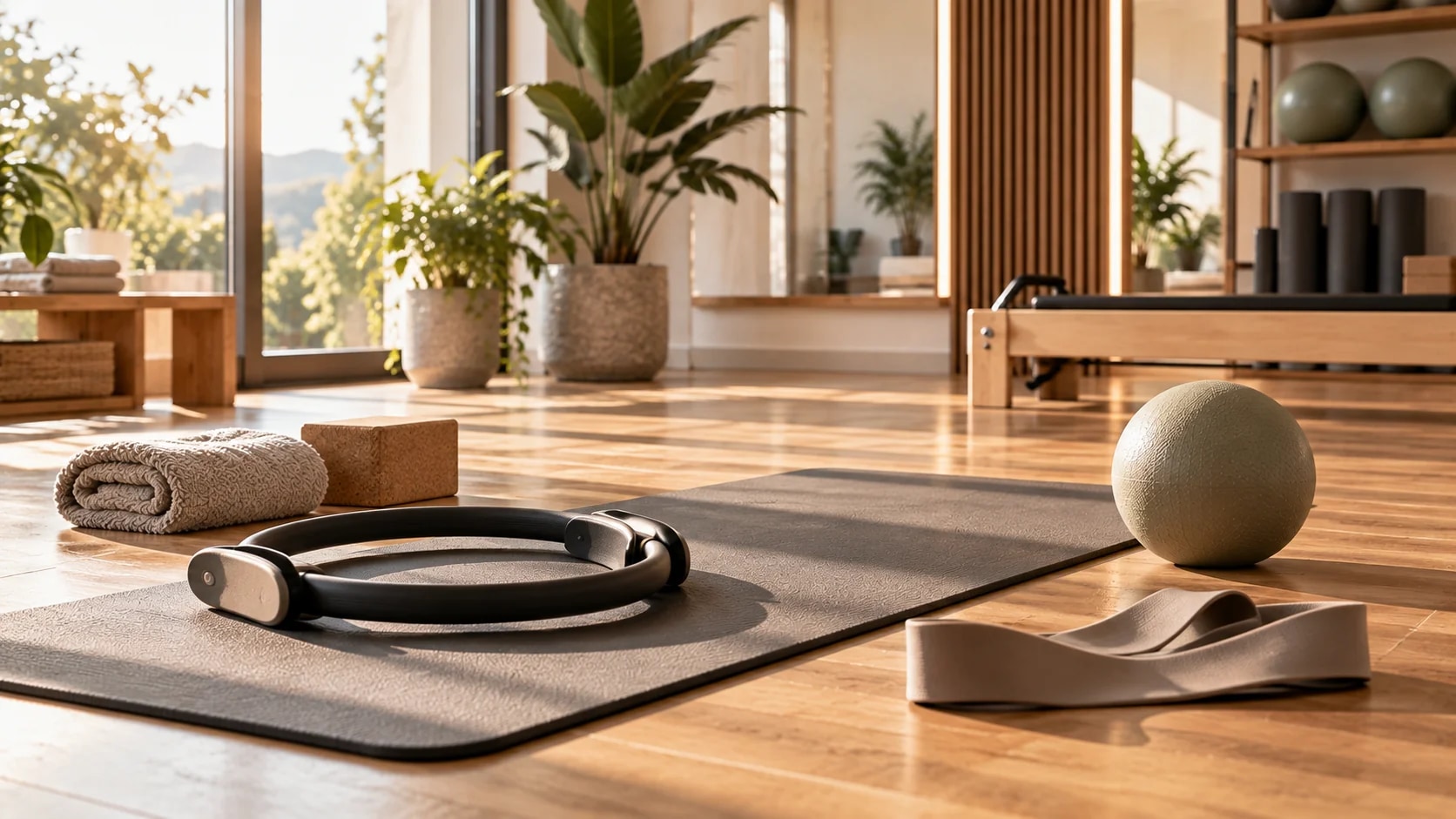
A non-slip mat is completely enough. Optionally, a Pilates ball, a ring, or a light resistance band expands the repertoire, but you don’t need them for the 10 basic exercises. Reformer training takes place in a studio.
What does Pilates with a trainer cost?
Group classes start at about €12 to €25 per session, and Reformer classes cost more. One-on-one training with a Pilates coach falls within the usual personal training range of €60 to €150 per hour, and the complete price overview is in the guide to personal trainer costs.
Is Pilates suitable for men too?
Yes, and historically it always has been: Joseph Pilates originally developed the method to train men, and today athletes from all disciplines use it as a foundation for stability. The high share of women in classes is a market trend, not a characteristic of the method.
Find, book, and pay your coach in one app
Verified Pilates coaches in Berlin and Hamburg, transparent prices, booking directly in the app.
View coachesThis guide does not replace individual training advice: if you have physical complaints, are pregnant, or have had an injury, getting started belongs in qualified hands. You can find, compare, and book verified Pilates coaches in the nucoach app, for Berlin and Hamburg.