
Ab Workout: The 12 Best Ab Exercises for Home and the Gym
Contents
- Which ab muscles are there and what do they do?
- Is ab training enough for a six-pack?
- The 12 best ab exercises
- Training your lower, upper and side abs
- Deep abs and core stability
- Ab workout for home: 15 minutes
- Ab exercises at the gym: machines and cables
- How often and how much? The training plan
- Back-friendly ab exercises
- What mistakes do beginners make in ab training?
- Ab training for women, men and people over 60
- Ab training with a coach: Pilates or personal training?
- Frequently asked questions
Which ab muscles are there and what do they do?
The abdominal muscles are made up of 4 muscles: the rectus abdominis, the external and internal obliques, and the transversus abdominis. Together they flex and rotate the torso, stabilize the spine and increase the pressure in the abdominal cavity. If you only do crunches, you mainly train one of these 4 muscles and largely leave the others out.
| Muscle | Location and function | Typical exercises |
|---|---|---|
| Rectus abdominis | Runs down the front from the breastbone to the pubic bone, flexes the torso forward and curls the pelvis up. Forms the six-pack at low body fat. | Crunch, reverse crunch, leg raise, hollow hold |
| External oblique | On the side and close to the surface, rotates the torso to the opposite side and bends it sideways. | Bicycle crunch, side plank, Pallof press |
| Internal oblique | Beneath the external oblique, rotates the torso to the same side and works together with the external oblique. | Side plank, Pallof press, cable wood chop |
| Transversus abdominis | Deepest layer, wraps around your midsection like a belt and stabilizes the spine and pelvis before any movement. | Dead bug, forearm plank, bird dog |
For your training, this means your abs have 2 kinds of jobs. On the one hand, they move your torso: flexing, rotating and bending sideways. On the other hand, they prevent movement, for example when you carry a heavy grocery bag on one side without tipping over, or keep your back straight during a deadlift. This stabilizing function is the more important one in everyday life and in sports. A good ab workout therefore includes both: exercises where your torso moves and exercises where it stays still under load.
Working closely with your abs are the pelvic floor, the diaphragm and the deep back muscles. Together they form what is often called the core in training. This teamwork explains why ab training is so often recommended for back problems, and why exercises like the bird dog and dead bug, which at first glance have little to do with the abs, are among the most effective ab exercises there are.
Is ab training enough for a six-pack?
A visible six-pack takes 2 things: sufficiently developed abs and a low body fat percentage. As a rough guide, abs become visible at about 10 to 12% body fat in men and at about 16 to 20% in women. In most cases, training alone isn’t enough for that, because the muscles sit under a layer of fat.
The most stubborn myth about ab training is spot reduction, the idea that lots of ab exercises burn fat right where you work. Studies have looked at this several times, for example with groups who did ab exercises every day for weeks. Each time, the results were similar: the abs got stronger, but belly fat didn’t shrink any more than it did without ab training. Your body draws energy from fat stores all over the body, and the order in which it does so is genetically determined and can’t be steered through your choice of exercises.
So if you want a flatter stomach and visible abs, you need 3 building blocks: a moderate calorie deficit, full-body strength training so you keep your muscle while losing weight, and targeted ab training so the muscles underneath show up as soon as the fat is gone. To work out your deficit, see the guide How to Calculate a Calorie Deficit: Formula, Examples, and Table; the overall concept is in the guide Weight Loss: What Really Works and What Doesn’t. For extra energy expenditure in little time, short interval sessions work well, as the guide HIIT Training: Exercises, Training Plan, and Effects for Beginners describes.
By the way, how many ab segments become visible, whether 4, 6 or 8, depends on your anatomy: the tendon bands that divide the rectus abdominis are something you’re born with, and you can neither train them away nor add to them. A slight asymmetry of the segments is also normal and no sign of faulty training.
The 12 best ab exercises
The 12 best ab exercises are the forearm plank, side plank, dead bug, bird dog, crunch, reverse crunch, bicycle crunch, lying leg raise, hollow hold, Pallof press, hanging knee raise and ab wheel rollout. The first 9 work at home without equipment, and the last 3 need a resistance band, a pull-up bar or an ab wheel.
| Exercise | How to do it | Beginner version and progression |
|---|---|---|
| 1. Forearm plank | Forearms under your shoulders, body straight from head to heels, abs and glutes tight, hold for 20 to 60 seconds | Start on your knees, progress with one leg lifted |
| 2. Side plank | Sideways on one forearm, hips lifted, body in one line, 15 to 45 seconds per side | Start with bent knees, progress with your top leg lifted |
| 3. Dead bug | On your back, arms toward the ceiling, knees bent over your hips, slowly extend the opposite arm and leg, lower back stays on the floor | Start with just the legs, progress by holding a dumbbell in your hands |
| 4. Bird dog | On all fours, extend the opposite arm and leg, keep your pelvis level, hold for 5 seconds | Start with just one leg, progress with an elbow-to-knee movement |
| 5. Crunch | On your back with knees bent, curl your upper body up one vertebra at a time until your shoulder blades lift off, lower back stays on the floor | Start with your hands on your thighs, progress with a weight plate on your chest |
| 6. Reverse crunch | On your back with your bent legs lifted, slowly curl your pelvis toward your chest and lower it with control | Start with a small range of motion, progress on a decline bench with your head at the high end |
| 7. Bicycle crunch | On your back with your shoulders slightly lifted, slowly rotate your elbow toward the opposite knee while extending the other leg | Start slowly with a pause in each position, progress with a 3-second hold |
| 8. Lying leg raise | On your back with your hands beside your hips, raise and lower your straight legs without letting your back arch | Start with bent knees, progress by lowering your legs to just above the floor |
| 9. Hollow hold | On your back, lift your shoulders and legs off the floor with your lower back pressed into the ground so your body forms a shallow bowl | Start with bent knees and your arms beside your body, progress with your arms overhead |
| 10. Pallof press | With your side to the band or cable, press the handle straight out from your chest and hold it without letting your torso rotate | Start in a wide stance with light resistance, progress in a half-kneeling position |
| 11. Hanging knee raise | Hang from a pull-up bar, draw your knees toward your chest with control, curling your pelvis up, without swinging | Start in a captain’s chair with arm supports, progress with straight legs |
| 12. Ab wheel rollout | Kneeling, roll the ab wheel forward, keep your back neutral, and pull back with your abs braced | Start with a short distance or against a wall, progress to a longer distance |
The order in the table is no accident. The first 4 exercises train stability, meaning the ability to keep your torso still while your arms and legs work. They are the foundation for everything else and are also suitable if you have back problems. Exercises 5 to 9 actively move the spine and mainly train the rectus abdominis and the obliques. Exercises 10 to 12 are the most demanding because they combine high forces with long levers.
For every exercise, slow and controlled beats fast and many. A crunch done with 2 seconds up and 2 seconds down challenges the muscles far more than 3 quick crunches using momentum. Exhaling during the hard phase helps build core tension and keeps you from holding your breath.
Training your lower, upper and side abs
The rectus abdominis is one continuous muscle and always works as a whole. Depending on the exercise, though, you can shift the emphasis to the upper or lower portion, and the side abs need their own exercises with rotation or side bending. The table shows which exercises emphasize which area.
| Area | Principle | Focus exercises |
|---|---|---|
| Upper abs | Upper body curls toward the pelvis, pelvis stays still | Crunch, cable crunch, weighted crunch |
| Lower abs | Pelvis curls toward the chest, upper body stays still | Reverse crunch, lying leg raise, hanging knee raise |
| Side abs | Rotation, side bending or resisting either | Side plank, bicycle crunch, Pallof press, cable wood chop |
| Deep abs | Keep the torso stable while your arms and legs move | Dead bug, forearm plank, bird dog |
For the lower abs, execution is what counts. Otherwise, your hip flexors quickly take over during leg raises: your legs go up and down, but your pelvis stays still and your lower back arches off the floor. Your abs only really get to work when your pelvis curls up slightly at the end of the movement, meaning your tailbone lifts off the floor. That’s why the reverse crunch, done with a small, clean movement, is the better exercise for most beginners than straight-leg raises.
Your side abs benefit most from exercises where you resist rotation. The Pallof press is the best example: the band pulls you sideways, and your job is to stay straight. That’s exactly the ability you need when carrying, throwing, punching and in any one-sided load in everyday life. Classic side bends holding a dumbbell in each hand, on the other hand, cancel each other out and accomplish little.
Deep abs and core stability
The deep abs are best trained with exercises where your torso stays stable while your arms and legs move. The dead bug, bird dog and forearm plank are the most important, and what matters is the right core tension. The transversus abdominis can’t be seen from the outside, but it’s one of the most important muscles there is for a resilient back.
There are 2 common methods for creating core tension. When drawing in, you gently pull your belly button toward your spine without holding your breath. This technique works well for feeling the deep muscles in the first place, for example after pregnancy or if your body awareness is low. When bracing, by contrast, you tighten the entire abdominal wall all the way around, as if you were about to take a light punch to the stomach. Your midsection becomes firm but not flat. For planks, squats, deadlifts and all exercises with load, bracing is the better choice because it stabilizes the spine all around.
How to do the forearm plank cleanly, how long you should hold it, and which 12 variations exist is covered in the guide How to Do a Plank Correctly. The body tension from core training also pays off in pushing exercises; more on that in the guide How to Do Push-Ups Correctly.
A simple test shows how good your core stability is: lie on your back as for the dead bug and slide one hand under your lower back. Now slowly extend one leg. If you feel the pressure on your hand ease off because your back arches, you still lack stability. In that case, reduce the range of motion until the pressure stays constant, then build back up over the following weeks. The same logic of controlled movement from a stable center is at the heart of Pilates; the basic exercises are shown in the guide Pilates Exercises: The 10 Most Important Moves to Do at Home, Explained.
Ab workout for home: 15 minutes
This ab workout takes 15 minutes, needs only a mat and trains all 4 abdominal muscles: a 3-minute warm-up, 3 rounds of 5 exercises each at 40 seconds with 20 seconds of rest, and 1 minute of rest between rounds. Beginners use the easier starting versions from the exercise table and start with 2 rounds.
| Phase | What you do | Duration |
|---|---|---|
| Warm-up | Cat-cow on all fours, pelvic tilts on your back, standing torso rotations, 20-second forearm plank | 3 minutes |
| Exercise 1 | Dead bug, slow and with your lower back pressed firmly into the floor | 40 seconds |
| Exercise 2 | Reverse crunch, curl your pelvis up with control | 40 seconds |
| Exercise 3 | Side plank, 20 seconds per side | 40 seconds |
| Exercise 4 | Crunch, 2 seconds up, 2 seconds down | 40 seconds |
| Exercise 5 | Forearm plank with firm core tension | 40 seconds |
| Sequence | 20 seconds of rest after each exercise, 1 minute after each round, 3 rounds in total | about 12 minutes |
After 2 to 3 weeks, swap individual exercises for harder variations: bicycle crunch instead of crunch, hollow hold instead of dead bug, side plank with a raised leg instead of a side plank on your knees. That keeps the stimulus high without making the workout longer. The workout is easy to tack onto a strength session, or you can do it as a short session of its own on non-training days.
Strengthen your abs and back with guidance
Pilates trains the deep abs more precisely than almost any other method, and a coach corrects every position. In the nucoach app, you compare verified coaches by specialty and price and book directly, for Pilates in Berlin and Pilates in Hamburg.
Ab exercises at the gym: machines and cables
At the gym you can progress ab exercises in a more targeted way with cables, weights and machines than with bodyweight alone. The most effective gym ab exercises are the cable crunch, hanging leg raise, cable Pallof press, wood chop and ab wheel. On top of that come the big compound lifts, which challenge your core strongly, if indirectly.
| Exercise | Equipment | Focus |
|---|---|---|
| Cable crunch | Cable machine set high, rope handle, kneeling | Rectus abdominis, easy to progress with added weight |
| Hanging leg or knee raise | Pull-up bar or captain’s chair | Lower portion of the rectus abdominis |
| Pallof press | Cable machine at chest height | Obliques and deep abs, anti-rotation |
| Wood chop | Cable machine set high or low, diagonal pull | Obliques, rotation with control |
| Ab machine | Crunch machine with weight stack | Rectus abdominis, simple for beginners |
| Squat and deadlift | Barbell or dumbbells | The entire core as a stabilizer under heavy load |
The advantage of machines is how easily you can progress. With the cable crunch, you can increase the weight in small steps and stay in the range of 8 to 15 reps, where muscles grow best. With bodyweight, trained people quickly manage 30 or 40 crunches, and beyond that each additional rep adds little.
People often underestimate how hard squats, deadlifts, overhead presses and lunges challenge the abs. During heavy compound lifts, your core works at full throttle to keep the spine stable. If you train these lifts regularly, you need less isolated ab training than someone who only works out on machines. To see how such a full-body plan is built, read the guide Strength Training for Beginners: Plan, Exercises and Getting Started; the movement patterns behind it are explained in the guide Functional Training: Exercises, Benefits and Who It’s For.
How often and how much? The training plan
For most goals, 2 to 3 ab sessions per week with 6 to 10 sets each are enough. You train dynamic exercises with 8 to 15 reps per set and hold exercises for 20 to 60 seconds. Leave at least 1 day of rest between 2 sessions, because your abs need time to recover, too.
| Level | Exercises per session | Sets and volume | Sessions per week |
|---|---|---|---|
| Beginner (weeks 1 to 4) | Forearm plank, dead bug, side plank, reverse crunch | 2 sets per exercise, 20 to 30 seconds or 8 to 10 reps | 2 |
| Build-up (weeks 5 to 8) | Plus crunch, bird dog, bicycle crunch | 2 to 3 sets, 30 to 45 seconds or 10 to 15 reps | 2 to 3 |
| Advanced (from week 9) | Hollow hold, Pallof press, hanging knee raise, ab wheel | 3 sets, harder variations or added weight | 2 to 3 |
The most important rule for progress is gradual progression. If every set of an exercise feels easy, make it harder: a longer lever, for example straight instead of bent legs, a slower tempo, an unstable surface or added weight. More reps are the weakest form of progression, because beyond about 20 to 25 reps the stimulus trains endurance rather than strength.
It makes the most sense to put ab training at the end of a strength session. Done beforehand, a fatigued core would weaken your stability in squats and deadlifts. To see how to combine abs, full-body strength, cardio and rest days into a weekly plan, read the guide How to Create a Training Plan in 6 Steps.
Back-friendly ab exercises
Back-friendly ab exercises strengthen your abs without repeatedly flexing the lumbar spine deeply. The best are the dead bug, bird dog, forearm plank, side plank, Pallof press and a crunch with a small range of motion, with one hand under your lower back. They suit beginners and people with back problems, and they serve as the basis for any ab training.
This approach became known through the Canadian spine researcher Stuart McGill, whose 3 basic exercises, a modified crunch, the side plank and the bird dog, feature in many physical therapy and training programs today. The idea behind it: your spine should stay stable while the muscles around it work. In the modified crunch, one leg stays straight and the other is bent, both hands lie under your lower back, and your head and shoulders lift only a few centimeters off the floor. The movement is small, yet your abs still work intensely.
Classic sit-ups with anchored feet, on the other hand, are not a good choice for most people. With your feet under wall bars or a sofa, the work shifts heavily onto the hip flexor, which attaches to the lumbar spine and pulls on it with every rep. If you have back problems, start with the stabilizing exercises and add dynamic variations only later. With acute, radiating or long-lasting pain, see a doctor for an evaluation before doing any exercise. The complete program for a resilient back is in the guide Back Pain: Exercises for Mobility and Stability.
What mistakes do beginners make in ab training?
The 6 most common mistakes are using momentum instead of control, arching your back during leg exercises, pulling on your neck, holding your breath, doing only crunches and training every day without progression. Each one costs you results, and some also strain your neck or back.
| Mistake | Do this instead |
|---|---|
| Using momentum | Slow tempo with 2 seconds up and 2 seconds down, with a short pause at the end position. |
| Arching your back during leg raises | Shorten the movement or bend your knees until your lower back stays on the floor. |
| Pulling on your neck | Rest your fingertips lightly at your temples, look diagonally upward and keep a gap between your chin and chest. |
| Holding your breath | Exhale during the hard phase, and keep breathing calmly during holds. |
| Only doing crunches | Include at least 1 stabilizing exercise, 1 flexing exercise and 1 for the side abs in every session. |
| Doing the same thing every day | 2 to 3 sessions per week and harder variations every 2 to 4 weeks. |
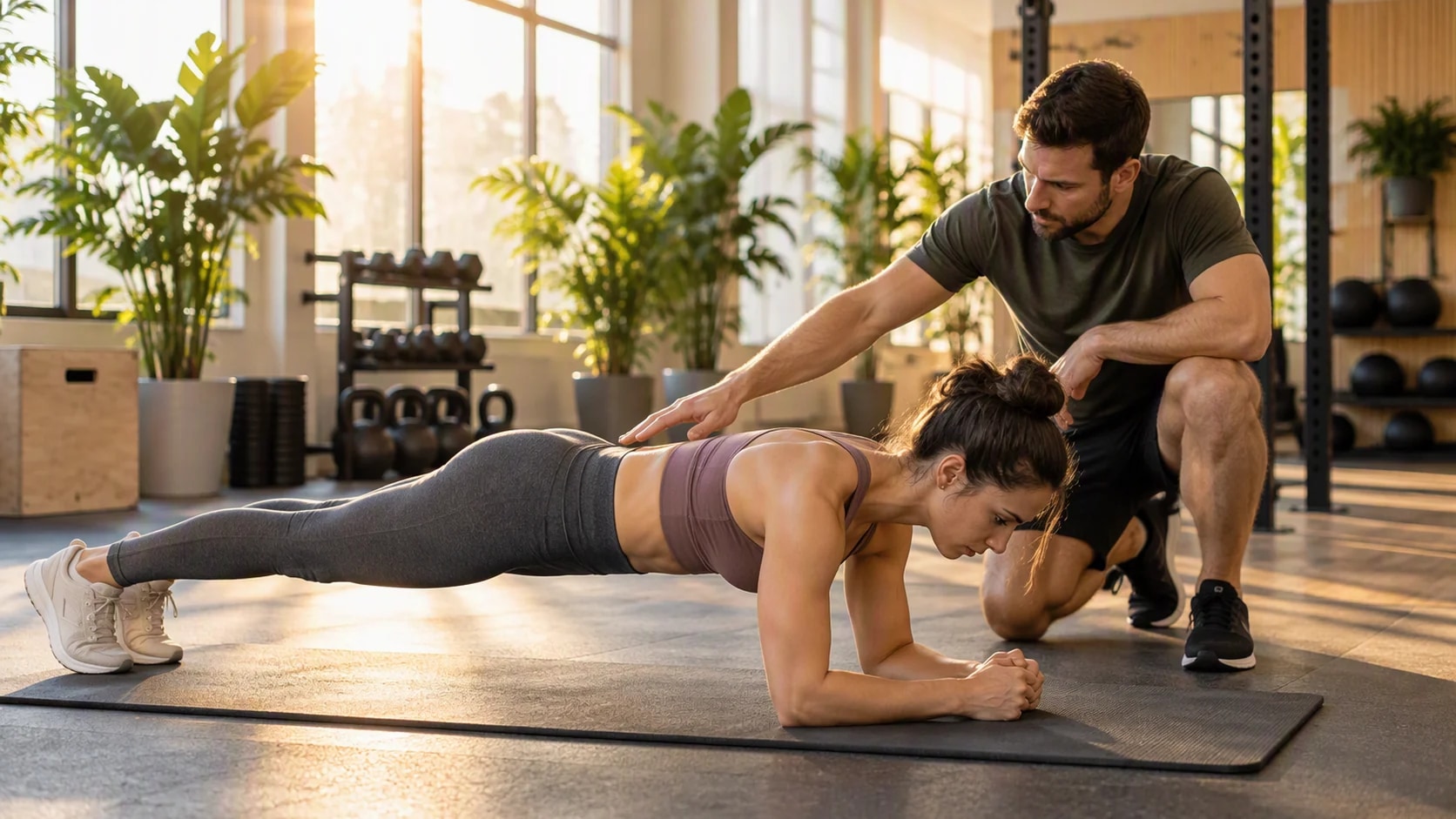
The forearm plank shows the most common posture mistake: your pelvis sags or sticks up too high. Both take the work off your abs. A simple check is a broomstick on your back: it should touch the back of your head, your shoulder blades and your glutes at the same time. If you’d rather hold 20 seconds in perfect position than 2 minutes with sagging hips, you’ll train far more effectively.
Ab training for women, men and people over 60
Ab training works on the same principles for women and men. The muscles are built the same way; the differences lie in starting strength, body fat distribution and in life stages such as pregnancy or older age. Exercise selection adapts to those stages, while the basic program stays the same.
On average, women store more body fat than men, including around the stomach and hips, which is why women’s abs become visible at a higher body fat percentage. The training itself doesn’t differ: for women, too, added weight and harder variations belong in the program once the basic exercises feel solid. The worry that ab training will give you a thicker waist is unfounded; the ab muscles are too flat for that.
After pregnancy, caution is needed. The rectus abdominis can have been pushed apart in the middle, technically called diastasis recti. A midwife, gynecologist or physical therapist checks the gap and clears you to train. You start with the pelvic floor and deep abs; classic crunches and heavy holds come in later. During pregnancy, too, your choice of exercises is agreed on with the professional looking after you.
From age 60, ab training becomes more important, because without training muscle strength measurably declines every year, and a stable core is directly linked to balance and fall prevention. Exercises while standing and sitting have proven their worth, such as the Pallof press with a band, a bird dog supported on a chair or a side plank against the wall. Floor exercises remain possible if getting back up works safely. With osteoporosis, strongly flexing exercises such as crunches and sit-ups should be cleared with a doctor.
Ab training with a coach: Pilates or personal training?
Guided ab training comes mainly in 2 formats: Pilates, with a focus on the deep abs, control and posture, and personal training, with a program tailored exactly to your goal and your body. Both solve the biggest problem of training alone: nobody can see whether your form is right.
Pilates mat classes in Berlin and Hamburg usually cost €15 to €30 per session depending on the studio, and private mat sessions cost €60 to €110 per hour. Pilates is especially well suited after pregnancy, for back problems and for anyone who first wants to develop a feel for the deep abs. Personal training typically costs €80 to €120 per hour and is worth it if you’re pursuing a specific goal, such as a flatter stomach combined with weight loss, or if physical issues call for an individual choice of exercises. Often 3 to 5 sessions are enough to lock in your technique and plan, so you can carry on training on your own afterward.
How to recognize a good coach for ab and core training: a good coach asks about back problems, pregnancies and pre-existing conditions before showing you the first exercise, starts with stability instead of crunches, and explains why a six-pack is built in the kitchen. The complete checklist is in the guide Find a Personal Trainer. You can find verified coaches in the nucoach app, for personal training in Berlin and personal training in Hamburg.
Book a trial session directly
Verified coaches for Pilates, functional training and personal training, with transparent prices in every profile.
Find a coach nowFrequently asked questions about ab training
How often should you train your abs?
Two to three sessions per week with 6 to 10 sets each are enough for clear progress. Your abs recover like any other muscle, so training them every day brings no extra benefit. More important than frequency is gradually progressing to harder variations.
Can you lose belly fat with targeted ab exercises?
No. Studies show that targeted ab training doesn’t reduce belly fat any more than training other muscles does. Your body loses fat through a calorie deficit, spread across the whole body. Ab exercises strengthen the muscles underneath, but they only become visible as your body fat percentage drops.
Which ab exercise is the best?
There is no single best exercise, because your abs consist of 4 muscles with different jobs. The forearm plank, side plank, dead bug, reverse crunch and Pallof press make a good foundation, and together they cover flexing, stabilizing and rotating against resistance.
Can you train your lower abs specifically?
The rectus abdominis is one continuous muscle that always works as a whole. Exercises in which the pelvis curls toward the chest, such as the reverse crunch and leg raise, do emphasize the lower portion more, though. Crunches in which the upper body curls toward the pelvis emphasize the upper portion.
Are sit-ups bad for your back?
Classic sit-ups with anchored feet put more stress on the lumbar spine and mainly train the hip flexor. For most people, crunches, the dead bug, forearm plank and side plank are the better choice. If you have back problems, start with stabilizing exercises that involve no spinal flexion.
How long does it take to see a six-pack?
That depends mainly on your body fat percentage. As a rough guide, abs become visible at about 10 to 12% body fat in men and about 16 to 20% in women. If you’re above that, you need a calorie deficit in addition to training, which takes a few months depending on your starting point.
Is ab training okay after pregnancy?
Yes, but only after postpartum recovery and with an adapted program. After birth, the rectus abdominis can be pushed apart in the middle, so-called diastasis recti. A midwife, gynecologist or physical therapist checks this and gives the all-clear, and you start with the deep abs and the pelvic floor.
Find, book and pay your coach in one app
Verified coaches in Berlin and Hamburg, transparent prices, and booking directly in the app.
View coachesThis guide is for general information only and does not replace medical or physical therapy advice. For acute or radiating back pain, during pregnancy, after childbirth, with osteoporosis or after surgery, your choice of exercises belongs in professional hands. You can find, compare and book verified coaches for Pilates, functional training and personal training in the nucoach app, for Berlin and Hamburg.