
Krav Maga for Beginners: Principles, Techniques and Getting Started
Contents
- What is Krav Maga?
- Where does Krav Maga come from?
- What principles are behind Krav Maga?
- What techniques do you learn in Krav Maga?
- Krav Maga vs. combat sports: what’s the difference?
- What does a Krav Maga session look like?
- How safe is Krav Maga training?
- What equipment do you need?
- How much does Krav Maga cost?
- Who is Krav Maga for?
- How do you find a good Krav Maga coach?
- Frequently asked questions
What is Krav Maga?
Krav Maga is a self-defense system that ends real attacks with the simplest, most direct techniques possible. The name is Hebrew and literally means “contact combat.” Unlike combat sports, Krav Maga has no competitive goal: there are no tournaments, no scoring and no techniques that only work in the ring.
The core idea is pragmatic. An attack on the street doesn’t announce itself, and it knows no weight class and no referee. That’s why Krav Maga builds on three things every person already has: natural protective reflexes, gross motor movements that still work under stress, and the weak points of the human body, which stay sensitive regardless of the attacker’s size and strength. A Krav Maga technique counts as good if it is solid after just a few weeks of training and still available when your pulse is at 180.
To see where it fits among fighting systems: Krav Maga is neither a traditional martial art with forms and belt rituals nor a competitive sport. It belongs to the group of self-defense systems, as the martial arts guide shows in its overview of all disciplines. Many techniques are borrowed from boxing, wrestling, judo and jiu-jitsu but have been reduced to their simplest, fastest form. What you won’t find in Krav Maga: complex combinations that take years of training, and techniques that only work against cooperative partners.
Where does Krav Maga come from?
Krav Maga comes from Imi Lichtenfeld (1910–1998), a boxer, wrestler and gymnast from Bratislava who, after emigrating to Palestine, turned his street-fighting experience from the 1930s into a military close-combat system. After about 20 years as a close-combat instructor for the Israeli army, he adapted the system for civilians starting in 1964. Since the 1980s, it has spread worldwide.
The stages of its development explain why Krav Maga looks the way it does today: it had to be learnable by recruits within a few weeks, work under extreme stress and put an opponent out of action quickly, with no regard for athletic fairness.
| Period | What happened |
|---|---|
| 1930s | In Bratislava, Imi Lichtenfeld uses boxing and wrestling to defend Jewish neighborhoods against antisemitic attacks, learning what works on the street and what only works in the ring. |
| 1940s | After arriving in Palestine, Lichtenfeld trains paramilitary units in close combat. The foundations of the later system take shape. |
| 1948 to 1964 | Lichtenfeld is chief instructor for close combat and physical fitness in the Israeli army. Krav Maga becomes the official military close-combat system. |
| From 1964 | After leaving the military, Lichtenfeld adapts the system for civilians: less intent to injure, more focus on de-escalation, breaking free and escape. |
| From the 1980s | Lichtenfeld’s students carry Krav Maga to the US and Europe. Several competing associations emerge, each with its own curriculum and grading levels. |
| Today | Krav Maga is taught worldwide to civilians, security forces and government agencies. Germany has no single umbrella association; schools belong to different international organizations or operate independently. |
For you as a beginner, the variety of associations is the most important takeaway from this history: there is no single, uniform Krav Maga. Curricula, grading levels and training style differ, sometimes significantly, depending on the organization and school. What a good curriculum has in common is covered in the section on principles.
What principles are behind Krav Maga?
Krav Maga follows a few fixed principles rather than a catalog of techniques: avoid danger if possible, defend and attack at the same time if necessary, hit sensitive targets in the process and end the situation as quickly as possible. Every technique in the system can be traced back to these principles, and that is exactly what makes Krav Maga so quick to learn.
| Principle | What it means in training |
|---|---|
| Avoid before you defend | Recognizing danger, keeping your distance, de-escalating and walking away come before any technique. The best fight is the one that never happens. That’s why situational awareness is part of every session. |
| Defense and counterattack at the same time | A defense on its own gives the attacker time for the next attack. In Krav Maga, a counterattack is therefore combined right away with the blocking movement, usually in a single motion. |
| Use natural reflexes | When something flies toward you, you instinctively raise your hands. Krav Maga techniques build on exactly such reflexes instead of replacing them with trained-in movements. That makes them available under stress. |
| Sensitive targets | Eyes, nose, throat, groin, knees and shins react regardless of the attacker’s strength and mass. That’s why Krav Maga works for smaller and physically weaker people. |
| Continuous motion | After the first hit, you don’t wait; you follow up with further actions until the danger is over. This principle is called Retzev in Hebrew and is practiced in drills with several follow-up techniques. |
| All-around awareness | Attacks rarely come from the front and rarely alone. That’s why training covers defense from all angles, watching for additional attackers and looking for an escape route while the situation is still unfolding. |
| Simplicity | A technique that needs 3 movements loses to one that needs 1. Krav Maga always chooses the most direct solution and cuts everything that only works against cooperative partners. |
Simplicity is also where reality differs most from what many beginners expect: Krav Maga looks unspectacular in training. No jumping kicks, no complex chains of joint locks, no forms. Instead, the movements become solid after a few weeks, and they work even in a winter jacket, on wet ground and at a heart rate where fine motor skills have long since failed.
What techniques do you learn in Krav Maga?
Krav Maga divides its techniques into striking and kicking techniques, defense against strikes and kicks, escapes from grabs and clinches, ground defense and defense against threats involving objects. Beginners start with the stance, the guard and direct strikes; defense against weapons comes only in the advanced levels.
| Technique area | Examples | Goal |
|---|---|---|
| Stance and movement | Neutral stance, fighting stance, steps in all directions | Control balance and distance |
| Direct strikes | Straight punches, palm-heel strike, elbow from close range, hammer fist | Stop the attacker without injuring your own hand |
| Kicks | Straight kick to the groin, knee from the clinch, kick to the knee or shin | Create distance, take away the attacker’s mobility |
| Defense against strikes | Inside and outside defenses with a simultaneous counterattack, 360-degree defense against circular attacks | Avoid getting hit and counter immediately |
| Escapes | Breaking free from wrist grabs, chokes from the front, behind and the side, bear hugs, hair pulls | Break the grip, counterattack, gain distance |
| Ground defense | Protective position on the ground, kicks from your back, getting up quickly | Spend as little time on the ground as possible |
| Threats involving objects | Defense against a stick, knife attack and threat, dealing with everyday objects | Advanced level, only after a solid foundation |
The palm-heel strike is a good example of the system’s logic: a closed fist takes weeks of conditioning before the wrist is stable enough, and on the street it often ends with broken hand bones. A strike with the heel of the palm hits the same zone, can be used from the very first session and doesn’t injure your own hand. If you still want to learn clean punches, you’ll find the technique in the guide to boxing training; many Krav Maga schools take their striking mechanics straight from boxing.
Alongside the techniques comes a second area of learning that gets just as much time in Krav Maga: what you do before and after the technique, such as using your voice, raising your hands visibly, demanding distance, scanning the area after the defense and leaving. A good school trains both, because a perfect escape is of little use if it’s unclear afterward where to go.
The curriculum is built in levels. Most organizations work with student, advanced and expert levels that you reach through exams; colored belts as in judo exist in only a few schools. Depending on the association, the first exam comes after several months of regular training and covers the stance, direct strikes and kicks, defense against straight attacks and the most important escapes. For you, that means the content of the first level is exactly what you’re most likely to need in everyday life.
Krav Maga vs. combat sports: what’s the difference?
The core difference is the goal: combat sports train for a fair match under rules; Krav Maga trains for a situation without rules, where all that matters is getting out unhurt. This leads to different techniques, a different training structure and a different approach to contact.
| Criterion | Krav Maga | Boxing, kickboxing, judo |
|---|---|---|
| Goal | End the attack, get to safety | Win the match, athletic development |
| Rules | None; whatever works is allowed | Fixed rulebook, prohibited targets and techniques |
| Permitted targets | Eyes, throat, groin and knees explicitly included | Exactly these targets are prohibited |
| Competitions | None | From club level to the pros |
| Learning curve until usable | Basics after 8 to 12 weeks | Several months to years to be competition-ready |
| Fitness effect | High, mainly through stress drills, but not the main goal | High; conditioning and technique are the core of training |
| Weapons and multiple attackers | A fixed part of the curriculum | Not covered |
What this means for your decision: if your main aim is to get fit, to test yourself against others or to master one discipline over the years, a combat sport will take you further; the martial arts guide compares the disciplines. If you want to feel safer in everyday life without ever stepping into a ring, Krav Maga is built for that. Many trainees combine both: boxing for conditioning and striking technique, Krav Maga for real emergencies. The combination works well because Krav Maga takes its striking mechanics from boxing anyway.
One misunderstanding should be cleared up here: Krav Maga is not automatically more effective than combat sports. A boxer with 3 years of training has enormous advantages over a Krav Maga beginner with 3 months in timing, distance control and the ability to take a hit. Krav Maga’s advantage lies in the speed with which people without an athletic background reach a usable level of defense, and in training situations that don’t occur in sport.
Find a Krav Maga coach in your city
Self-defense one-on-one or in a small group: in the nucoach app, you compare verified coaches for Krav Maga and other disciplines by format and price and book your trial session directly, for martial arts in Berlin and martial arts in Hamburg.
What does a Krav Maga session look like?
A Krav Maga session lasts 60 to 90 minutes and follows a fixed structure: warm-up, calm technique work, technique with a partner, stress drill, cool-down. The stress drill sets Krav Maga apart from almost any other training: a technique only counts as learned once it works under exhaustion, noise and surprise.
| Phase | Duration | Content |
|---|---|---|
| Warm-up | 10 to 15 minutes | Running, mobilization, reaction games, often already with partner contact so that touch becomes normal |
| Calm technique work | 15 to 20 minutes | A new technique is explained slowly and practiced without resistance; the coach corrects posture, distance and target selection |
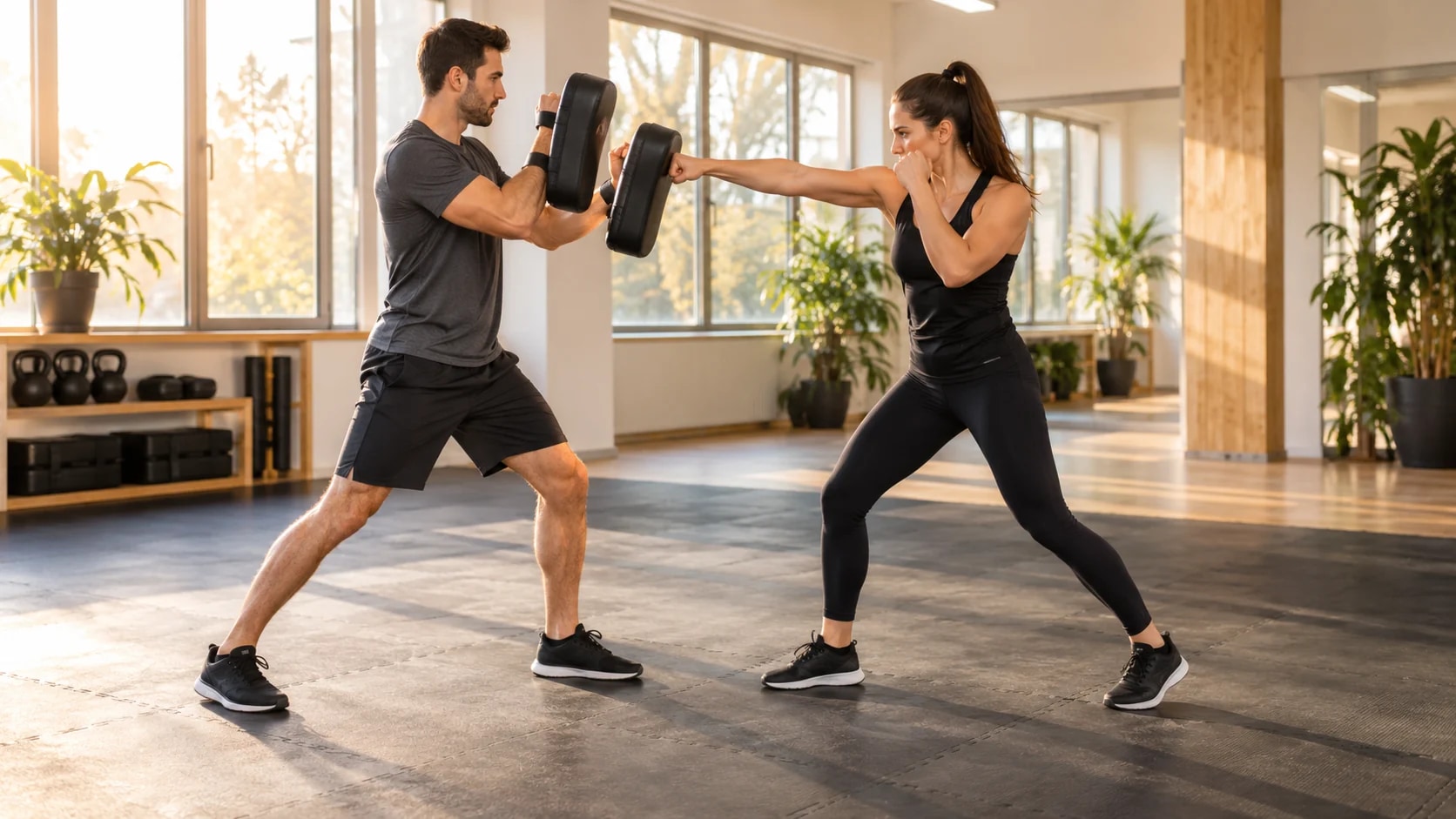
| Technique with a partner | 15 to 20 minutes | The partner attacks at increasing speed, focus mitts and protective pads come into play, and counterattacks are struck with power |
| Stress drill | 10 to 15 minutes | Technique under load: after sprints or push-ups, with eyes closed until the attack, against several partners or with noise |
| Cool-down | 5 to 10 minutes | Easy cool-down, stretching, a debrief of the session, often a short scenario discussion |
The fitness effect of this structure is substantial. A session with stress drills taxes the cardiovascular system, core, legs and shoulders about as intensely as a boxing session, and the calorie burn, depending on body weight and intensity, is in a comparable range of several hundred kilocalories per hour. If you train Krav Maga twice a week, you usually don’t need any additional conditioning work. The underlying movement patterns (rotating, pushing, pulling, getting up quickly) are explained in the guide to functional training.
In personal training, the session looks a bit different: warm-up and cool-down are shorter, the technique portion is tailored to your situation (commute, job, physical prerequisites), and the coach takes on the attacker role themselves, wearing protective gear. As a result, in 10 one-on-one sessions you often learn as much as in 20 to 25 evening classes.
How safe is Krav Maga training?
Krav Maga training is safe under good instruction, because techniques are struck on focus mitts, protective pads and cooperative partners, and free sparring with full contact is not part of standard training. The risk of injury is therefore clearly lower than in competitive sports with sparring, but it demands discipline from everyone involved.
The typical minor injuries are bruises on forearms and shins from defense drills and the occasional jammed finger. Serious injuries almost always come from an over-eager partner, not from the technique itself. You can recognize a good school by the fact that the coach controls the intensity, attacks are initially carried out slowly and protective gear is used consistently, even if it looks unspectacular.
An honest note on health: if you have pre-existing conditions or problems with your joints, back or cardiovascular system, get a check-up with your doctor before you start. The stress drills push your heart rate to high values, and the escape techniques put strain on wrists and shoulders. Both are unproblematic for healthy people, but this is not training you jump into after years of inactivity without talking to a doctor first.
Safety also has a legal side. In Germany, Section 32 of the Criminal Code (Strafgesetzbuch) governs legal self-defense (Notwehr): any defense that is necessary to avert an imminent or ongoing unlawful attack is permitted. Anyone who keeps hitting after the attack has ended goes beyond this framework. Reputable Krav Maga schools cover this in class, because otherwise the principle of continuous motion is misunderstood: it means acting until the danger is over, and then stopping immediately and leaving. A coach who never addresses the legal situation and proportionality provides incomplete training.
What equipment do you need?
To get started, you need comfortable workout clothes, clean gym shoes and a groin guard; everything else is provided in most classes. As the intensity increases, you add your own gloves, mouthguard and shin guards, which together are a manageable purchase.
| Equipment | What it’s for | When to get it |
|---|---|---|
| Workout clothes and gym shoes | Freedom of movement, grip on mats and gym floors | From the first session |
| Groin guard | Mandatory, because kicks to the groin are a fixed part of training | From the first session; get your own for hygiene reasons |
| Open-finger gloves (MMA style) or boxing gloves | Protect your hands when striking focus mitts; open-finger gloves allow grabbing | After 2 to 3 sessions, once it’s clear you’re sticking with it |
| Mouthguard | Protection during partner drills with contact to the head | As soon as partner drills pick up speed |
| Shin guards | Protection when defending against kicks and with leg-on-leg contact | Advanced partner drills |
| Focus mitts, strike pads, training knives | Training equipment for the coach, not something you buy | Provided by the school or coach |
The recommendation from practice: train 2 to 3 sessions with loaner gear first, then buy. That way you’ll know whether open-finger gloves or boxing gloves suit you better and which size fits. Your coach will advise you on what to choose, and many schools have gear you can try.
How much does Krav Maga cost?
Krav Maga costs about €20 to €40 per class session in Berlin and Hamburg, course blocks start at around €150, and one-on-one training with a coach falls within the usual personal training range of €60 to €150 per hour. Which model is worth it depends on how quickly you want to reach a usable level.
| Format | Cost | Who it’s for |
|---|---|---|
| Group class or small group | €20 to €40 per session, blocks from around €150 | Beginners with time who want group dynamics and plenty of partners to practice with |
| One-on-one with a coach | €60 to €150 per hour, 10-session packages usually cheaper | Anyone who wants to reach a specific goal quickly, such as everyday safety before a trip or after an incident |
| Combination model | Class plus 1 to 2 private sessions per month | Most people: group for repetition and partner variety, private session for technique correction |
| Intensive workshop | Day or weekend formats, price depends on the provider | A starting overview, but no substitute for regular training |
To put these prices in perspective: a personal trainer adds especially much value in Krav Maga, because playing the attacker is demanding. An experienced coach attacks realistically, dials the intensity and immediately recognizes when a movement falls apart under stress. For what personal training costs in general and how to save with packages, see the guide to personal trainer costs.
Who is Krav Maga for?
Krav Maga is suitable for adults of any age and fitness level who want to feel safer in everyday life, especially for people without athletic experience, for women and for anyone whose job involves dealing with conflict. Children have their own programs with adapted content.
The reason Krav Maga works for so many people lies in the system itself: it doesn’t rely on strength, speed or years of technique, but on principles that any body can carry out. A person weighing 55 kilograms can escape a chokehold using the same techniques as one weighing 95 kilograms, because the technique relies on leverage and sensitive targets. That’s exactly why Krav Maga has one of the highest shares of women among fighting systems, and many schools in Berlin and Hamburg offer women-only classes.
Four groups benefit especially: people who have experienced a threatening situation and want to regain the ability to act; professionals who deal with conflict, such as in emergency services, nursing, security or nightlife; athletic people who find combat sports too competition-oriented but are looking for the intensity and the mental side; and parents who want their children to learn to set boundaries and recognize danger. For them there are kids’ classes from around age 6, where running away, being loud and simple escapes are the focus, not striking and kicking techniques.
Two things should be clear before you start. First: Krav Maga training involves physical contact. Anyone who doesn’t want to be touched won’t be happy with the training, even though getting used to contact is itself an important part of safety. Second: Krav Maga doesn’t make you invulnerable. Good training therefore always teaches first how to avoid and leave situations, and only then how to fight back. Schools that advertise toughness and readiness to fight are training the opposite.
How do you find a good Krav Maga coach?
You can recognize a good Krav Maga coach by a traceable education with association membership or documented gradings, by a trial session without a contract commitment, and by the fact that they take avoidance and de-escalation as seriously as technique. Because Germany has no single association, the quality of the coach’s training is your most important criterion.
Concretely, 5 questions are worth asking in the initial consultation: Which organization did the instructor complete their training with, and when did they last take continuing education? How is the intensity managed for beginners? What protective gear is mandatory? How many participants are there per coach in class? And: is there a trial session before a contract is signed? A school that answers all 5 questions clearly takes training and safety seriously. The complete checklist with warning signs, which applies to any coach, is in the guide to finding a personal trainer.
At the trial session itself, watch for 3 things: Are new techniques explained slowly and without resistance before speed is added? Does the coach correct individual participants or only demonstrate? And at the end of the session, do they talk about behavior, avoidance and the legal situation or only about technique? A coach who knows and explains the limits of self-defense under German law trains responsibly.
In Berlin and Hamburg, you’ll find Krav Maga classes at specialized self-defense schools, at martial arts gyms with their own Krav Maga program and with independent coaches who train one-on-one or in small groups, at a gym, in a park or at your home. The overview of disciplines, prices and neighborhoods is on the pages martial arts in Berlin and martial arts in Hamburg.
Book a trial session directly
Verified coaches for Krav Maga and self-defense with transparent prices in every profile.
Find a coach nowFrequently asked questions about Krav Maga
Is Krav Maga a combat sport?
No. Krav Maga is a self-defense system without competitions, a rulebook or weight classes. You train for real-world situations with the goal of ending an attack as quickly as possible and getting to safety. Combat sports such as boxing or judo, by contrast, train for a fair match under fixed rules; the martial arts guide shows the comparison.
Is Krav Maga suitable for beginners with no prior experience?
Yes. Krav Maga is designed specifically so that people with no athletic background can learn it in a short time. The techniques build on natural protective reflexes, and the basics become solid after about 8 to 12 weeks of regular training. The only requirement is that your first sessions are guided by an instructor.
How often per week should I train Krav Maga?
One or two sessions per week are enough for visible progress, and two sessions speed up learning considerably. Because the techniques have to be available under stress, regular repetition matters more than long individual sessions.
How much does Krav Maga cost?
Group classes and small groups in Berlin and Hamburg cost about €20 to €40 per session, and course blocks start at around €150. One-on-one training with a coach falls within the usual personal training range of €60 to €150 per hour; the details are in the guide to personal trainer costs. In most classes, the equipment you need to get started is provided.
Is Krav Maga suitable for women?
Yes. Krav Maga is one of the self-defense systems with the highest share of women, because the techniques rely not on physical strength but on leverage, sensitive targets and surprise. Many schools in Berlin and Hamburg offer women-only classes and classes on everyday safety.
Is there Krav Maga for kids?
Yes, many schools offer classes for children and teens starting at around age 6. The focus there is on recognizing danger, setting boundaries, running away and simple escape techniques, not on the striking and kicking techniques used in adult training.
How long does it take until I can defend myself with Krav Maga?
The most important basic techniques (stance, guard, escapes from grabs, defense against straight attacks) become solid after 8 to 12 weeks with 1 to 2 sessions per week. Being able to use them under stress usually takes several months, which is why stress drills belong in your training from the start.
Find, book and pay for a coach in one app
Verified coaches in Berlin and Hamburg, transparent prices, sessions booked right in the app.
View coachesThis guide does not replace individual training advice or legal advice on self-defense: if you have health complaints, pre-existing conditions or have been inactive for a long time, get started with qualified guidance. You can find, compare and book verified Krav Maga coaches in the nucoach app, for Berlin and Hamburg.