
Stretching Exercises: The Key Stretches for Back, Hips, Neck, and Legs
Contents
- What does stretching really do?
- Static or dynamic: Which stretching method and when?
- How do you stretch correctly?
- Stretches for the lower back and hips
- Stretches for the neck and shoulders
- Stretches for the legs
- The 10-minute routine for your whole body
- Stretch before or after your workout?
- What mistakes do beginners make when stretching?
- Who needs stretching most?
- Stretching with a coach: yoga, Pilates, or personal training?
- Frequently asked questions
What does stretching really do?
Stretching reliably delivers one thing above all: a greater range of motion in your joints. After 4 to 8 weeks of regular stretching, the gain is measurable, often clearly so in the hips and hamstrings. It can also ease feelings of tightness, and everyday movements like bending, twisting, or reaching overhead get easier.
This guide does have to correct 2 expectations, though, because they have been handed down for decades and research doesn’t support them. 1. Stretching doesn’t prevent sore muscles. Large reviews of the research show that stretching before or after a workout neither prevents muscle soreness nor noticeably shortens it. 2. Stretching doesn’t lower the risk of injury across the board. A proper warm-up with dynamic movements protects better than minutes of static stretching on cold muscles.
What stretching does accomplish is worth more in everyday life than the myth: if you sit 8 hours a day, your hip flexors, chest muscles, and hamstrings become functionally shortened. The result is a posture that strains the lower back and neck. Targeted stretches for exactly these regions counteract that, and within just a few weeks. For strength athletes, more flexibility means deeper squats with clean technique, for runners a longer stride, for martial artists higher kicks. Stretching is the foundation that all other forms of training build on.
Static or dynamic: Which stretching method and when?
There are 2 main methods: static stretching holds a position for 15 to 30 seconds, while dynamic stretching moves the joint in a controlled way through its full range of motion without holding. Static stretching belongs after a workout or in separate sessions, dynamic stretching in the warm-up. There are also 2 specialized forms for advanced exercisers.
| Method | How it works | When to use it |
|---|---|---|
| Static stretching | Get into the position until you feel a clear pull, hold it calmly for 15 to 30 seconds, 2 to 4 repetitions. No bouncing. | After workouts, in separate stretching sessions, in the evening against tightness |
| Dynamic stretching | Controlled, flowing movements through the full range of motion: leg swings, lunges with rotation, arm circles. 8 to 12 repetitions per side. | Warm-up before every workout, especially before strength training, sprinting, and martial arts |
| Active static stretching | The opposing muscle of the stretched muscle is tensed, for example the quadriceps when stretching the hamstrings. Hold for 10 to 15 seconds. | Advanced exercisers, yoga, martial arts |
| PNF stretching | Alternating 5 to 6 seconds of tensing against resistance with a deeper stretch right after, usually with a partner or coach. | Targeted flexibility work, rehab-style applications, only with guidance |
For beginners, the first 2 methods are plenty. The rule of thumb: anything you do before a workout is movement. Anything you do after it, or in a separate session, can be held. PNF stretching brings the fastest progress but requires proper guidance, because the tensing phase overloads tendons and their attachments when it’s dosed wrong.
How do you stretch correctly?
Stretching correctly means stretching warm, breathing calmly, without pain, and with the right dose: hold for 15 to 30 seconds, repeat 2 to 4 times, about 60 seconds of total stretching time per muscle group, at least 2 to 3 times a week. This dose matches the recommendations of sports science societies and is enough for measurable progress.
| Rule | Why it applies |
|---|---|
| Only stretch statically when warm | Cold muscles and tendons are less elastic. Five minutes of easy movement, or the workout itself, is enough preparation. |
| Tension of 6 to 7 out of 10 | A clear pull, yes; pain, no. If you stretch into pain, you trigger a protective reflex: the muscle tenses up instead of giving way. |
| Keep breathing calmly | With every exhale, the muscle gives a little. Holding your breath raises baseline tension and blocks progress. |
| 15 to 30 seconds, 2 to 4 repetitions | About 60 seconds of total stretching time per muscle group. More time per position doesn’t bring any additional flexibility gain. |
| Don’t bounce | Bouncing movements in static stretching stimulate the muscle spindles and raise the risk of strains. Dynamic stretching means flowing and controlled. |
| Both sides equally | The stiffer side gets one extra repetition, otherwise side-to-side differences grow and make posture and technique worse. |
| Regular instead of long | Ten minutes every day beat 60 minutes on Sunday. Flexibility is an adaptation that needs frequent stimuli. |
A note on safety: sharp, electric, or radiating pain in your arm or leg while stretching usually comes from a nerve or joint. If that happens, release the position immediately and have it checked by a doctor if it recurs. The same applies to stretching after fresh injuries, after surgery, or with known disc problems: there, the choice of exercises belongs in the hands of a doctor or physical therapist.
Stretching doesn’t need much equipment. A non-slip mat protects your knees and wrists in the kneeling and hands-and-knees positions. A strap or a towel extends your arms in the lying hamstring stretch, so the leg stays straight instead of your back making up for the missing length. A yoga block or a thick book under your hand brings the floor closer in forward folds and keeps your back long. You don’t need more than that to start. In the office, a chair with a backrest replaces mat and block at the same time: foot on the seat for the hip flexors, hands on the backrest for the chest and shoulder stretch.
Stretches for the lower back and hips
The most effective stretches for the lower back target the hip flexors, glutes, and hamstrings, because these muscles shorten in people who sit a lot and pull the lower back into an unfavorable position. The 5 exercises below cover exactly this chain.
| Exercise | How to do it | Duration |
|---|---|---|
| Knee to chest | Lie on your back, pull one knee to your chest with both hands, and leave the other leg straight on the floor. Your lower back stays on the floor. | 30 seconds per side, 2 repetitions |
| Lying rotation stretch | Lie on your back, bend one knee and guide it across the straight leg to the side with the opposite hand. Your shoulders stay on the floor, and you look toward your free hand. | 30 seconds per side, 2 repetitions |
| Child’s pose | Sit on your heels, fold your torso forward onto your thighs, arms extended forward, forehead to the floor. Sink deeper with every exhale. | 45 to 60 seconds |
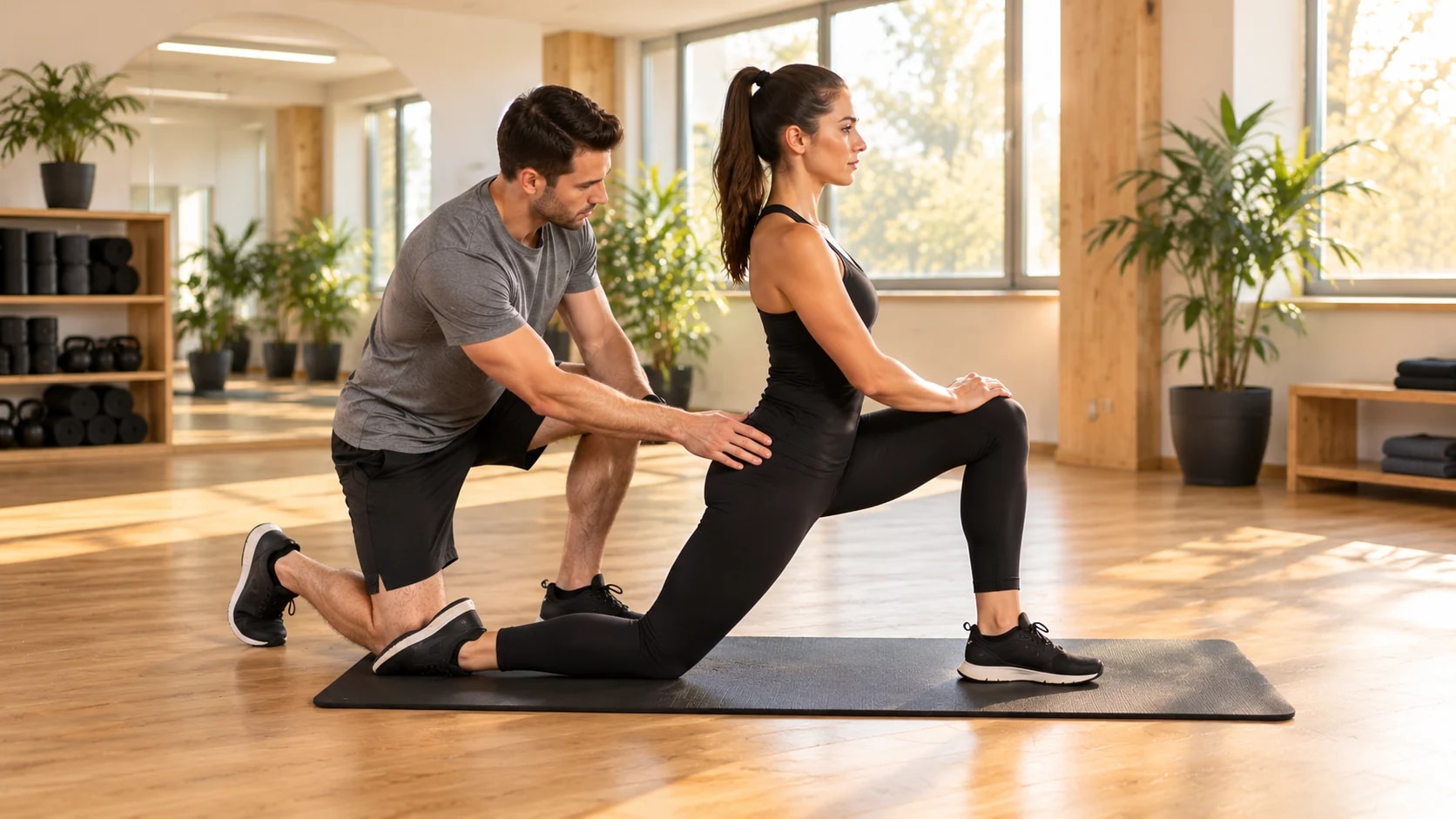
| Kneeling hip flexor stretch | Kneel, place one foot forward, push your pelvis forward, torso upright, glutes engaged. You feel a pull in the groin of the back leg. | 30 seconds per side, 2 repetitions |
| Glute stretch (pigeon) | Sitting or lying on your back, cross one leg over the other and pull the bottom leg toward your chest. You feel a pull in the glute of the top leg. | 30 seconds per side, 2 repetitions |
The hip flexor stretch is the most important exercise in this group and also the one that is done wrong most often: if you tilt your pelvis forward and arch into a hollow back, you’re not stretching anything. It works when the glute of the back leg stays firmly engaged and the pelvis is tucked upright; then even a small push forward is enough for a clear pull. How these exercises fit into a complete program of mobilization and stabilization is shown in the guide Back Pain: Exercises for Mobility and Stability.
Stretches for the neck and shoulders
Stretches for the neck and shoulders target the upper trapezius, the levator scapulae, the chest muscles, and the rotators, in other words the muscles that are permanently shortened and under tension during screen work. All 5 exercises work while sitting, and therefore also at your workstation.
| Exercise | How to do it | Duration |
|---|---|---|
| Side neck stretch | Sit up straight and tilt your head to the side, ear toward shoulder, while the opposite hand gently pulls toward the floor. Your shoulder stays down. | 20 to 30 seconds per side |
| Chin to chest with a turn | Lower your chin to your chest, then turn your head slightly to the side as if you wanted to look into your armpit. Stretches the levator scapulae. | 20 to 30 seconds per side |
| Doorway chest stretch | Place your forearm against the door frame at a right angle and slowly turn your upper body forward until you feel a pull in your chest. Don’t let your shoulder drop forward. | 30 seconds per side, 2 repetitions |
| Cross-body stretch for the back of the shoulder | Pull one arm across your body at shoulder height and use the other hand on the elbow to press it toward your chest. | 20 to 30 seconds per side |
| Overhead triceps and lat stretch | Raise one arm overhead, bend the elbow, put your hand between your shoulder blades, gently pull the elbow back with the other hand, and lean your upper body slightly to the opposite side. | 20 to 30 seconds per side |
Neck stretches tolerate less pull than any other region. The cervical spine is mobile and sensitive, so the rules here are: never pull with force, never circle your head, and never stretch into pain. Stop immediately if you feel dizzy, get tingling in your arms, or develop a headache during the stretch. For people who sit a lot, the combination of chest stretch and neck stretch is the most effective, because the shortened chest pulls the shoulders forward and the neck carries the load.
For neck tension, stretching works best together with mobilization and strengthening. 12 exercises with a 10-minute routine are covered in the guide Neck Pain Exercises.
Stretches for the legs
Stretches for the legs cover 5 muscle groups: the hamstrings, the quadriceps, the calves with the Achilles tendon, the adductors on the inner thigh, and the glutes. Runners, strength athletes, and martial artists need all 5, while people who sit a lot mainly need the hamstrings and hip flexors.
| Exercise | How to do it | Duration |
|---|---|---|
| Lying hamstring stretch | Lie on your back with one leg extended upward, hold behind the thigh with a band, towel, or your hands, and pull your foot toward your body. The other leg stays on the floor. | 30 seconds per side, 2 repetitions |
| Standing quad stretch | Bend one leg and pull the foot toward your glute with the hand on the same side, knees pointing down side by side, pelvis tucked upright. Steady yourself with your free hand. | 30 seconds per side, 2 repetitions |
| Calf stretch at the wall | Hands on the wall, one leg back, heel on the floor, knee straight. For the deep calf muscle and the Achilles tendon, use the same position with a slightly bent knee. | 30 seconds per variation and side |
| Butterfly stretch for the adductors | Sit with the soles of your feet together and let your knees sink outward, torso upright, elbows pressing gently on your knees. | 45 to 60 seconds |
| Deep lunge with rotation | Dynamic variation: take a big step forward, lower the back knee toward the floor, rotate your upper body toward the side of the front leg, come back, and switch sides. | 8 to 10 repetitions per side, before the workout |
The hamstrings are the muscle group where beginners cheat most often: if you reach for your toes while standing with a rounded back, you shift the pull into your back. The lying variation forces you into clean execution because your back is fixed to the floor. For runners, calves and Achilles tendon belong in the program after every session, for strength athletes the quadriceps and hip flexors after every leg day, and for martial artists the adductors and hamstrings set the limit for the height of every kick, as the kickboxing guide describes.
The 10-minute routine for your whole body
A full-body stretching routine takes 10 minutes, 8 exercises, and no equipment if it works from the bottom up through the large muscle chains and holds each position for 30 seconds. Done daily, it does more in 4 to 8 weeks than any occasional long stretching session.
| Order | Exercise | Duration |
|---|---|---|
| 1. | Calf stretch at the wall, both sides | 2 x 30 seconds |
| 2. | Kneeling hip flexor stretch, both sides | 2 x 30 seconds |
| 3. | Lying hamstring stretch, both sides | 2 x 30 seconds |
| 4. | Lying glute stretch, both sides | 2 x 30 seconds |
| 5. | Lying rotation stretch, both sides | 2 x 30 seconds |
| 6. | Child’s pose | 60 seconds |
| 7. | Doorway chest stretch, both sides | 2 x 30 seconds |
| 8. | Side neck stretch, both sides | 2 x 30 seconds |
The routine works as a finisher after any workout or as a separate evening session, ideally after 5 minutes of easy movement. If you only have 5 minutes, take exercises 2, 3, 7, and 8; that covers the 4 regions that shorten the most in people who sit a lot. If you want to build flexibility systematically into a weekly plan, you’ll find the structure in the guide Strength Training for Beginners, where the routine belongs at the end of each session.
You can check whether the routine works with 3 simple tests that you repeat every 4 weeks. For the hamstrings, sit on the floor with your legs straight and note how far your fingertips reach toward your feet. For the hip flexors, lie on your back at the edge of the bed, pull one knee to your chest, and see whether the thigh of the other leg lies flat or rises. For the shoulders, reach behind your back with one hand from above and the other from below and measure the gap between your fingers. A photo or a short note per test is enough. It’s important to always do the tests at the same time of day and after the same short warm-up, because flexibility is lower in the morning than in the evening. If you see no progress after 8 weeks, you’re usually stretching too rarely or from an unfavorable starting position, and both can be sorted out in 1 to 2 supervised sessions.
Build flexibility with guidance
Yoga, mobility training, or personal training with a focus on flexibility: in the nucoach app, you compare verified coaches by specialty and price and book your trial session directly, for yoga in Berlin and yoga in Hamburg.
Stretch before or after your workout?
The answer is clear: dynamically before the workout as part of the warm-up, statically after the workout or in separate sessions. Long static stretching right before strength, sprint, or jump loads lowers performance by a few percent in the short term. This effect is well documented in studies and the reason the old gym-class habit of stretching before a run is now considered outdated.
The mechanism behind it: static stretching for more than 60 seconds per muscle group temporarily reduces the stiffness of the muscle-tendon unit and the neural activation of the muscle. That is exactly what you want for flexibility, but it gets in the way of force production for the following 10 to 30 minutes. Short static stretching of under 30 seconds per muscle, on the other hand, causes hardly any measurable loss in performance, but before a workout it also brings no advantage over a dynamic warm-up.
In practice, that means: before the workout, 5 to 10 minutes of leg swings, lunges with rotation, arm circles, hip circles, and light squats. After the workout or in the evening, the static routine. There is one exception: if you can’t perform an exercise with clean technique because you lack the flexibility, for example a deep squat because of shortened hip flexors, you may also briefly stretch the affected muscle group statically before the workout. The small loss of strength weighs less than the better technique. Which movement patterns take center stage here is explained in the functional training guide.
Rest days are the most valuable time for flexibility. Your body isn’t fatigued, the muscles respond well to calm static stretching, and you can do the routine without time pressure. That’s why many people make the evening their fixed slot for the 10 minutes, for example before brushing their teeth or after a warm shower, when the tissue has better blood flow anyway. You may stretch with sore muscles as long as the tension stays moderate. Intense stretching of an already irritated muscle tends to prolong recovery rather than speed it up. Gentle movement, walking, and light dynamic exercises feel better and make more sense on such days than a hard stretching program.
What mistakes do beginners make when stretching?
The 6 most common mistakes are stretching cold, stretching into pain, bouncing, holding your breath, a wrong starting position, and not stretching often enough. Each one costs you progress, and the first 3 also raise the risk of injury.
| Mistake | Do this instead |
|---|---|
| Stretching statically when cold | Do 5 minutes of easy movement beforehand or put the routine at the end of your workout. |
| Stretching into pain | Stay at 6 to 7 out of 10 on the tension scale. More pull triggers the protective reflex, and the muscle shuts down. |
| Bouncing | Hold statically or deliberately move dynamically and fluidly. Jerky movements at the end point stimulate the muscle spindles. |
| Holding your breath | Keep breathing calmly and deeply, and sink a little deeper into the stretch with each exhale. |
| Wrong starting position | A rounded back in forward bends or a hollow back in the hip flexor stretch shifts the pull into the back. Tuck your pelvis upright and brace your core. |
| One hour once a week | Ten minutes every day. Flexibility needs frequent, short stimuli. |
The mistake with the biggest impact is the starting position. A coach sees within seconds whether your pelvis is tilted or your back is rounded, and corrects it with one hands-on adjustment. If you train alone, use a mirror or a video from the side: back long, pelvis tucked upright, and only then move into the stretch.
Another common misconception is that a foam roller replaces stretching. Both methods improve range of motion in the short term but work differently: the roller temporarily reduces the tissue’s sensitivity to tension, while stretching trains the nervous system’s tolerance for the end position. In practice, they complement each other well. If you roll for 30 to 60 seconds over the quadriceps or calf and then stretch the same muscle group right away, you usually get noticeably further than with either method alone. Rolling the lower back, on the other hand, doesn’t make sense, because the lumbar spine has no bony protection. Child’s pose works better there.
Who needs stretching most?
Stretching makes sense for everyone, but especially for 4 groups: people with sedentary jobs, strength athletes, runners and martial artists, and people over 50 whose flexibility measurably declines without training. Each group has its own priorities.
People who sit a lot need the hip flexors, hamstrings, chest, and neck, the 4 regions that 8 hours in a chair shorten the most. For them, the 5-minute short version of the routine does more every day than anything else. Strength athletes stretch the muscle groups they have worked after the workout, mainly the hip flexors, quadriceps, and chest, so that squats, deadlifts, and bench presses stay clean through the full range of motion. Runners take care of calves, Achilles tendon, hamstrings, and hip flexors after every session, because the repetitive load shortens exactly this chain.
For the workplace, a mini routine that works without a mat and without attracting attention has proven its worth: while seated, pull your chin to your chest and slowly tilt your head to both sides, 20 seconds each. Then clasp your hands behind your back, lift your breastbone, and squeeze your shoulder blades together for 20 seconds. Get up, put one foot on the chair, tuck your pelvis upright, and stretch the hip flexor of the back leg for 20 seconds, then switch sides. Finally, put your heel on the chair, keep your back long, and lean slightly forward with a straight torso, 20 seconds per side. That takes under 3 minutes and can be repeated 2 to 3 times a day, ideally tied to fixed triggers like the end of a meeting or the walk to the coffee machine.
Martial artists in kickboxing, taekwondo, or karate have the highest flexibility needs of all groups: the adductors, hamstrings, and hips decide the height and cleanliness of every kick, which is why dynamic stretching before and static stretching after every session is standard for them. And for people over 50, stretching is an investment in independence: mobility in the hips, shoulders, and spine determines whether tying shoes, reaching overhead, and turning around stay effortless in everyday life. Here, consistency counts for more than intensity.
Stretching with a coach: yoga, Pilates, or personal training?
Guided flexibility training comes in 3 formats: yoga combines stretching with strength, balance, and breathing, Pilates puts core control and clean movement at the center, and personal training builds the stretching work specifically around your limitations and your sport. All 3 solve the biggest problem of stretching alone: nobody corrects your starting position.
Yoga is the right choice if you want flexibility as part of a holistic practice, with set sequences and your breath setting the rhythm; the 10 most important positions to start with are in the guide Yoga Exercises: The 10 Most Important Asanas for Beginners. Pilates fits if you want the core at the center and want to combine flexibility with stability; the guide Pilates Exercises: The 10 Most Important Moves to Do at Home, Explained shows the basic exercises. Personal training is worthwhile if a specific limitation blocks your technique in your sport or if physical issues call for a tailored selection of exercises. In 3 to 5 sessions, you learn the positions so that you can then perform them cleanly on your own.
How to recognize a good flexibility coach: a good coach asks about any aches, pains, and pre-existing conditions before showing the first exercise, corrects your starting position instead of just deepening the stretch, and explains the difference between a pull and pain. The complete checklist for choosing a coach is in the guide Find a Personal Trainer. You can find verified coaches for yoga, mobility, and personal training in the nucoach app, for personal training in Berlin and personal training in Hamburg.
Book a trial session directly
Verified coaches for yoga, mobility, and personal training with transparent prices in every profile.
Find a coach nowFrequently asked questions about stretching exercises
How long should you hold a stretch?
Hold static stretches for 15 to 30 seconds per position and repeat them 2 to 4 times, which adds up to about 60 seconds of total stretching time per muscle group. Holding a stretch longer than 60 seconds in one go brings no additional flexibility benefit.
Should you stretch before or after a workout?
Before a workout, stretch dynamically, meaning with movement and without long holds; after a workout or in separate sessions, stretch statically. Long static stretching right before strength or sprint training temporarily lowers performance by a few percent.
Does stretching help with sore muscles?
No. Research reviews show that stretching before or after a workout neither prevents muscle soreness nor noticeably shortens it. Stretching improves flexibility and can ease feelings of tightness; against sore muscles, light movement, sleep, and time help.
How often per week should you stretch?
At least 2 to 3 times a week, ideally every day in short 10-minute sessions. Measurable gains in flexibility show up after 4 to 8 weeks of regular stretching.
Which stretches help with tightness in the lower back?
Knee to chest while lying down, the lying rotation stretch, child’s pose, and the kneeling hip flexor stretch. Important: if the pain is acute, radiating, or lasts longer than 2 weeks, see a doctor before doing any exercise. The complete program is in the guide Back Pain: Exercises for Mobility and Stability.
Should stretching hurt?
Stretching should pull noticeably, but it shouldn’t hurt. The right intensity is about 6 to 7 out of 10 on a tension scale. If you feel sharp or radiating pain, release the stretch immediately: those are warning signs from a nerve or joint.
Are yoga and stretching the same thing?
No. Yoga includes many stretching positions but combines them with strength, balance, and breath control in a fixed sequence. Pure stretching targets individual muscle groups and fits into any workout in 10 minutes.
Find, book, and pay for a coach in one app
Verified coaches in Berlin and Hamburg, transparent prices, booking directly in the app.
View coachesThis guide is for general information and does not replace medical or physical therapy advice. In cases of acute pain, radiating symptoms, or after injuries or surgery, the choice of exercises belongs in the hands of a doctor or therapist. You can find, compare, and book verified coaches for yoga, mobility, and personal training in the nucoach app, for Berlin and Hamburg.