
Kickboxing: Styles, Techniques, and Getting Started for Beginners
Contents
- What is kickboxing?
- What styles of kickboxing are there?
- What techniques do you learn in kickboxing?
- Kickboxing, boxing, Muay Thai, or karate: what is the difference?
- What are the benefits of kickboxing?
- How does a kickboxing session work?
- Do you need sparring, and how safe is kickboxing?
- What equipment do you need?
- How does the belt system work?
- How much does kickboxing cost?
- Who is kickboxing suitable for?
- Kickboxing with a coach or at a club?
- Frequently asked questions
What is kickboxing?
Kickboxing is a standing martial art that combines punches with the fists and kicks with the legs and, depending on the style, is fought with no, light, or full contact. Unlike Muay Thai, classic kickboxing does without elbows, knees, and the clinch; unlike boxing, it allows kicks to the body and head.
Kickboxing grew out of a simple question: what happens when karate fighters face boxers? In the 1960s in the US, karate competitors began combining their kicks with boxing gloves and boxing technique in order to fight full-contact bouts. In parallel, a variant developed in Japan that blended karate with elements of Muay Thai. Both lines still shape the sport today: the American line led to point fighting, light contact, and full contact with kicks above the belt line, the Japanese line to the K-1 style with low kicks and knees.
Worldwide, the sport is organized mainly through WAKO, the World Association of Kickboxing Organizations, which has held world championships since the 1970s and is represented in Germany by a national federation. Numerous other federations and professional organizations with their own rulebooks exist as well. For you as someone who trains, this is secondary at first: the basic techniques are the same in all styles, and most kickboxers in Berlin and Hamburg train without any competitive ambition, for fitness, technique, and a clear head. How kickboxing stacks up against other disciplines is covered in the martial arts guide.
What styles of kickboxing are there?
Kickboxing has 5 styles that differ mainly in the contact allowed and the permitted target zones: point fighting, light contact, full contact, low kick, and K-1 style. Fitness kickboxing comes on top as a non-contact workout format with no competitive element.
| Style | Contact and target zones | Who it’s for |
|---|---|---|
| Point fighting (semi-contact) | Light, controlled contact. The fight is stopped after every hit and a point is scored. Kicks and punches only above the belt line. | Beginners, kids, people who focus on technique |
| Light contact | Continuous fighting with controlled power; a knockout is not the goal. Target zones as in point fighting. | Advanced beginners who want to fight without hitting hard |
| Full contact | Full power, knockouts possible. Kicks and punches above the belt line, no low kicks. | Competitors with several years of experience |
| Low kick | Like full contact, plus kicks to the thighs are allowed. | Competitors, transition to K-1 style |
| K-1 style | Full contact with low kicks, knee strikes, and a short clinch. Named after the Japanese tournament series K-1, which started in 1993. | Experienced fighters, close to Muay Thai |
| Fitness kickboxing | No contact. Techniques on pads, heavy bag, and in the air, combined with conditioning and strength exercises. | Anyone who wants conditioning and technique without fighting |
For beginners, the distinction matters mainly when you look at what a gym offers. A gym that advertises K-1 trains harder and closer to competition than a club focused on point fighting. Both are legitimate, and both have their place. If you’re putting on gloves for the first time, a program with fitness kickboxing or semi-contact is the gentler start, and switching to harder styles later is always possible.
Fitness kickboxing deserves a closer look because it is the format most beginners in Berlin and Hamburg actually start with. It takes over the techniques of kickboxing but dispenses with partner contact entirely: you punch and kick pads, a heavy bag, and the air, often to the rhythm of music and combined with squats, push-ups, and core exercises. The training effect for conditioning, flexibility, and coordination is almost identical to classic training; only timing, a sense of distance, and the ability to take a hit stay out of the picture. If you later want to move into martial arts, fitness kickboxing already gives you clean basic techniques.
What techniques do you learn in kickboxing?
The foundation of kickboxing consists of 4 basic punches from boxing, 3 basic kicks, and the footwork that ties them together. You learn these basics in your first 6 to 8 sessions; everything else is combinations and variations of them.
| Technique | Execution | What it trains |
|---|---|---|
| Jab | Fast straight punch with the lead hand | Distance, timing, speed |
| Cross | Powerful straight punch with the rear hand, driven by the hip rotation | Rotation, punching power |
| Hook | Punch from the side with a bent arm | Torso rotation, short range |
| Uppercut | Punch from below, driven up from the legs | Leg strength, extension |
| Front kick (straight kick) | Kick straight forward with the ball of the foot or the heel, lift the knee first | Creating distance, hip power |
| Roundhouse kick | Kick driven by a hip rotation, landing with the shin or instep on the leg, body, or head | Hip mobility, balance, the most important kicking technique |
| Side kick | Kick with the edge of the foot from a sideways position | Core stability, supporting leg |
| Footwork | Steps, changes of direction, weaving, retreating after every combination | Endurance, coordination, guard |
The roundhouse kick is the technique that defines kickboxing. Done cleanly, it starts from the hip, the supporting leg pivots with it on the ball of the foot, and the strike lands with the shin rather than the foot. This rotation is exactly what feels unfamiliar to beginners and the reason the first weeks are more balance work than strength work. The punching technique, by contrast, is identical to boxing, and the boxing training guide explains jab, cross, hook, and uppercut in detail. Many kickboxing coaches have their beginners do almost nothing but box in the first sessions before kicks are added.
On top of the attacking techniques come defense and guard: blocks with the arms and shins, evading through footwork, checking low kicks with a raised leg. Experienced coaches always teach offense and defense as a pair, because in sparring a combination without a guard afterward is an invitation to a counter.
The 5 most common beginner mistakes can all be fixed in the first few weeks if someone is watching: The kick comes from the knee instead of the hip and loses reach and power. The supporting leg doesn’t pivot, which strains the knee. The guard drops while kicking. Kicks go too high too early, before the hips are mobile enough. And breathing stalls in the combination instead of exhaling with every strike. Because of exactly these 5 points, the first sessions with a coach are worth it: a rotation that has been drilled in wrong is hard to correct later.
Kickboxing, boxing, Muay Thai, or karate: what is the difference?
The difference lies in which parts of the body may be used as weapons: boxing uses only the fists, kickboxing fists and feet, Muay Thai adds elbows, knees, and the clinch, and karate combines punches and kicks with forms, tradition, and mostly semi-contact. This leads to different learning curves, loads, and goals.
If you’re interested in the variant with elbows, knees, and the clinch (close-range fighting while standing), you’ll find its origins, technique, and how to get started in the Muay Thai guide.
| Criterion | Kickboxing | Boxing | Muay Thai |
|---|---|---|---|
| Allowed techniques | Fists and feet, in K-1 style also knees | Fists only | Fists, feet, elbows, knees, clinch |
| Target zones | Head and body, in low kick also the thighs | Head and body above the belt line | Whole body except groin and back |
| Learning curve for the basics | 6 to 8 sessions | 4 to 6 sessions | 8 to 12 sessions |
| Main load | Whole body, especially hips and legs | Shoulders, core, footwork | Whole body, heavy load on the shins |
| Non-contact variant | Fitness kickboxing, pad work | Fitness boxing, heavy bag, focus mitts | Mitt and pad work |
| Origin | US and Japan, 1960s and 1970s | England, 18th century, modern rules in 1867 | Thailand, national sport with centuries of tradition |
Karate is deliberately missing from the table because it has no uniform competition format: traditional karate trains forms (kata) and semi-contact with etiquette and a belt system, while full-contact karate comes close to kickboxing. If you want structure and tradition, karate is the better home; if you want intensity and a round-based format, kickboxing is. And if you mainly want to defend yourself in everyday life, you’ll find the system designed for exactly that in the Krav Maga guide, without competition and without rules.
What are the benefits of kickboxing?
Kickboxing delivers one of the highest calorie burns among fitness sports, mobility in the hips and legs, core strength, coordination, and a mental reset that hardly any machine-based workout provides. The full-body effect comes from every technique loading the legs, hips, core, and arms in one chain.
| Benefit | What is behind it |
|---|---|
| High calorie burn | Depending on body weight and intensity, about 500 to 800 kcal per hour. The round structure with short breaks works like interval training, and energy expenditure stays elevated after the session. For weight loss, the calorie balance still decides, as the weight loss guide shows. |
| Flexibility | High kicks demand flexible hip flexors, adductors, and hamstrings. Regular kickboxers gain noticeable hip mobility within 2 to 3 months, an effect that pure boxing doesn’t have. |
| Core and leg strength | Every kick stands on one leg, every rotation runs through the core. Kickboxing is therefore applied functional training; the basics are explained in the functional training guide. |
| Coordination and balance | Punch-kick combinations, switching the supporting leg, and evasive movements train the interplay of eyes, nerves, and muscles. Beginners notice progress in their balance first. |
| Clear head | Combinations on pads demand full concentration. Many people therefore experience kickboxing as the most effective counterbalance to their working day; ruminating is simply impossible during a round. |
An honest note on expectations: as with any training, visible changes to the body take several weeks to months of consistency. A realistic frame for first clear effects on conditioning, flexibility, and body tension is 2 sessions per week over 3 months.
How does a kickboxing session work?
A kickboxing session lasts 60 to 90 minutes and follows a round-based format: warm-up, technique, pad or partner work, conditioning, cool-down, usually in rounds of 2 to 3 minutes with 1 minute of rest. The structure repeats in almost every gym and every personal training session; only the weighting of the parts shifts.
| Phase | Duration | Content |
|---|---|---|
| Warm-up | 10 to 15 minutes | Jump rope, running, hip and shoulder mobility work, dynamic stretching of the hamstrings |
| Technique | 15 to 20 minutes | Shadowboxing in front of the mirror, a new technique or combination at a calm pace, the coach corrects hip rotation, supporting leg, and guard |
| Pads or partner | 15 to 25 minutes | Combinations at full power on pads and shin pads, in advanced training light-contact drills with a partner |
| Conditioning and strength | 10 to 15 minutes | Heavy bag rounds, core exercises, squats, push-ups, often as a circuit |
| Cool-down | 5 to 10 minutes | Easy cool-down jog, static stretching of the hips, legs, and shoulders |
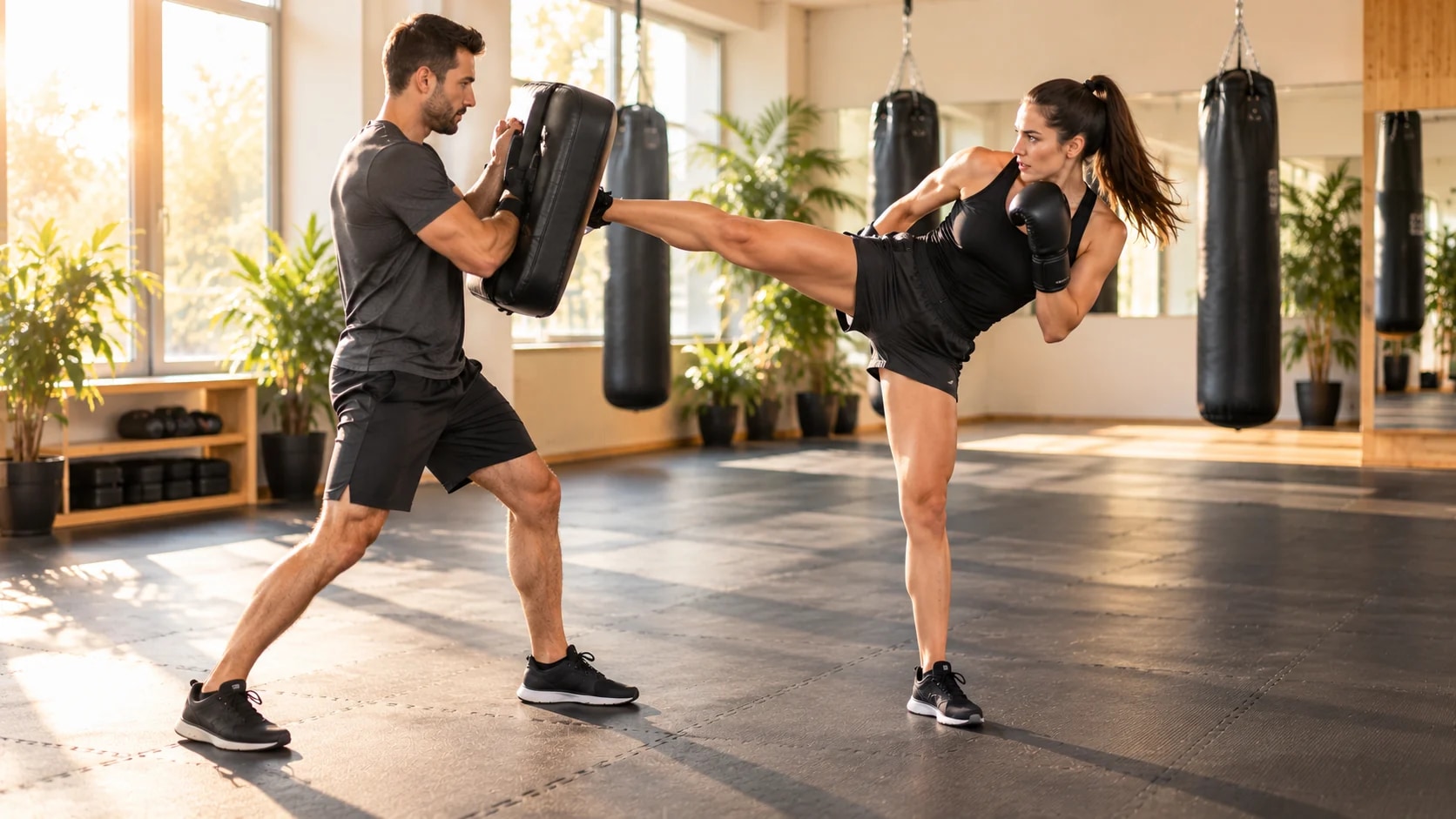
In personal training, the weighting shifts toward technique and pad work: the coach holds the pads, calls out combinations, and corrects every repetition in real time. This is the most intense and most instructive form of kickboxing training, because mistakes in hip rotation or guard show up immediately instead of becoming ingrained over weeks.
On training frequency: 2 sessions per week is the sweet spot for beginners, 3 sessions for advanced trainees with competitive ambition. Between 2 sessions there should be at least 1 rest day, because kickboxing stresses the hips, legs, and shoulders intensely and adaptation happens during recovery. If you also want to build conditioning, add jump rope or easy running on your off days, but no further session with kicks.
Between coached sessions, kickboxing is easy to practice on your own, with little space and no equipment. The most effective method is shadowboxing in front of a mirror: 3 to 5 rounds of 2 minutes each with 1 minute of rest, in which you repeat the combinations from your last session slowly and cleanly. At first, practice kicks only up to hip height and focus on pivoting the supporting leg; the height comes as your mobility grows. The jump rope is ideal for warming up and for footwork: 3 rounds of 3 minutes each train rhythm, calf strength, and endurance. If you have a heavy bag, you can also throw punch-kick combinations with power, always with wraps and gloves. The key is to practice on your own only the techniques your coach has already worked through with you. Drilling new techniques without correction is the most common reason mistakes in hip rotation and guard become ingrained. A short phone video of your shadowboxing helps you ask targeted questions at your next session and makes your progress visible over several weeks. After every solo session, 5 to 10 minutes of stretching for the hip flexors, adductors, and hamstrings pays off, because exactly these muscles limit the height and cleanliness of your kicks.
Do you need sparring, and how safe is kickboxing?
Sparring is voluntary in kickboxing, comes after several months of technical training at the earliest, and in reputable gyms takes place only at light contact with full protective gear. If you use kickboxing as a fitness format, you’ll never take a hit.
The typical bumps and bruises in kickboxing training come mainly from technical work: shin against elbow on a roundhouse to the pad, bruised toes from front kicks that land sloppily, pulled hamstrings from kicks that go too high without a sufficient warm-up. All 3 can be almost completely avoided with shin guards, clean technique, and a full warm-up. You can recognize a good school by the fact that new techniques are practiced slowly and low at first, before speed and height are added.
A note on health: high kicks stress the hips and hamstrings, and rotation techniques stress the knee of the supporting leg. If you have existing knee, hip, or back problems, get checked by a doctor before you start, and the first sessions should be guided so that no harmful movement patterns become ingrained. For healthy people of any age, kickboxing with correct technique is a safe sport, and its intensity can be adjusted freely through pace, kick height, and number of rounds.
Find a kickboxing coach in your city
One-on-one pad work, fitness kickboxing, or technique from scratch: in the nucoach app you compare verified coaches by discipline, format, and price and book your trial session directly, for martial arts in Berlin and martial arts in Hamburg.
What equipment do you need?
For kickboxing you need hand wraps, boxing gloves, shin guards, and a groin guard, plus a mouthguard for partner drills and headgear only for sparring. The basic kit is a one-time, manageable purchase, and in the first sessions most gyms provide loaner gear.
| Equipment | What it’s for | When to buy |
|---|---|---|
| Hand wraps | Stabilize the wrist and knuckles under the glove, the most important and cheapest item | From the first session |
| Boxing gloves | Measured in ounces (oz): 10 to 12 oz for pads and bag, 14 to 16 oz for partner work and sparring, heavier gloves have more padding | After 2 to 3 sessions with loaner gear |
| Shin guards | Protect the shin and instep when kicking pads and when blocking, indispensable in kickboxing | As soon as kicks are thrown with power, usually from week 2 |
| Groin guard | Mandatory for all partner drills, get your own for hygiene reasons | From the first partner drill |
| Mouthguard | Protects teeth and jaw on contact to the head | Once partner drills start at pace |
| Headgear | Mandatory in sparring, in competition depending on style and federation | Only for sparring |
| Foot protectors | Padded foot covers for point fighting and light contact | Only for these styles |
When buying shin guards, 2 details are worth a look: a model with instep protection also protects the toes on roundhouse kicks, and the length has to run from the knee to just above the ankle; guards that are too short slip and don’t protect the point of impact. Your coach will advise you on size and model, and many gyms have pairs you can try.
How does the belt system in kickboxing work?
The belt system in kickboxing is modeled on karate, usually runs from white through yellow, orange, green, blue, and brown to black, and is earned through tests whose content and waiting periods vary by federation and school. There is no uniform, worldwide system like in judo.
In the lower grades, tests cover the basic stance, the 4 basic punches, the basic kicks, simple combinations, and footwork; in the upper grades, partner combinations, defensive techniques, conditioning components, and often light-contact sparring. Between 2 tests there are usually 3 to 6 months of regular training, and the path to a black belt takes several years in most systems.
For your decision, the belt is secondary. Many gyms and independent coaches work without any grading at all and train purely by skill, while clubs use the belt system as a motivational and structural framework. Both work. If measurable intermediate goals matter to you, ask about the testing system at your trial session; if fitness is your priority, you can do without it.
How much does kickboxing cost?
Kickboxing costs about €15 to €30 per small-group session in Berlin and Hamburg, €30 to €80 per month at a gym or club, and €70 to €150 per hour in one-on-one training with a coach, typically €80 to €120. Which model fits depends on your goal, your time, and the learning curve you want.
| Format | Cost | Who it’s for |
|---|---|---|
| Small group with a coach | €15 to €30 per session | Beginners, conditioning focus, group dynamics |
| Gym or club membership | €30 to €80 per month | Regular training with classes and solo training, usually with a contract commitment |
| One-on-one technique training | €80 to €120 per hour, range €70 to €150 | Fastest learning curve, clean technique from the start |
| 10-session package, one-on-one | 20 to 40% below the single-session price | Anyone who keeps going regularly after the trial session |
| Combination model | Membership plus 1 to 2 individual sessions per month | Most people: group for conditioning and routine, individual session for technique correction |
For perspective: one-on-one pad work is the most expensive format per hour and the cheapest per technique learned, because every repetition is corrected. If you learn the basics cleanly in 10 individual sessions and then keep training in a class or on the bag, you save yourself the trouble of unlearning bad patterns. What personal training costs in general and which models exist is covered in the personal trainer costs guide.
Who is kickboxing suitable for?
Kickboxing is suitable for beginners and advanced trainees of any age, for women and men alike, and, as fitness kickboxing, also for anyone who never wants to fight. Children start in their own classes, usually from age 6.
The share of women in kickboxing has been growing for years, and for good reason: with the legs, hips, and core, kickboxing trains exactly the body regions many women want to strengthen in a targeted way, it can be done entirely without contact, and the intensity is freely scalable. Many gyms in Berlin and Hamburg offer women-only classes; the technique there is identical to mixed training, only the makeup of the group differs.
Children and teenagers benefit from kickboxing above all in coordination, discipline, and self-confidence. In kids’ training from about age 6, strikes are thrown only on pads and strike pads, contact to the head is off limits, and sparring, if it happens at all, takes place only as point fighting with full protective gear. At the trial session, parents should pay close attention to how the school handles contact in the kids’ class.
Kickboxing is a particularly good fit for 3 groups: people who find classic endurance training boring and are looking for interval training that engages the mind. People who sit a lot, have lost hip mobility and rotation, and want both back. And anyone looking for a mental counterbalance where everyday life stays outside. If, on the other hand, you mainly want everyday safety, a pure self-defense system like Krav Maga gets you to the goal more directly: kickboxing is first and foremost a sport with rules.
Kickboxing with a coach or at a club?
The clear recommendation for getting started: the first 5 to 10 sessions guided, ideally with a coach on the pads, and after that combined as needed with a club, class, or training on the bag. Kickboxing is technically more demanding than it looks, and the hip rotation decides both the effect and your joint health.
The club is the cheapest route and offers group dynamics, fixed training times, and usually a belt system, but each trainee gets only a few corrections per session. The gym with a class schedule sits in between on price and is more flexible with times. The personal trainer offers the fastest learning curve and the only form in which every technique is corrected immediately; they come to the gym of your choice, to the park, or to your home. For most people the combination model works best: one guided session per week plus 1 to 2 solo sessions on the bag or with a jump rope.
How to recognize a good kickboxing coach: by verifiable trainer education or competition experience, by a trial session without a contract commitment, by technique work before conditioning work, and by sparring staying voluntary. The complete checklist with initial consultation questions and warning signs, which applies to every coach, is in the Find a Personal Trainer guide. In Berlin and Hamburg, you can find kickboxing coaches and gyms on the pages for martial arts in Berlin and martial arts in Hamburg, with disciplines, prices, and neighborhoods at a glance.
Book a trial session directly
Verified coaches for kickboxing and fitness kickboxing with transparent prices in every profile.
Find a coach nowFrequently asked questions about kickboxing
What is the difference between kickboxing and boxing?
In boxing, only punches above the belt line are allowed. Kickboxing adds kicks, depending on the style to the torso, to the head, and, in the low kick style, to the legs as well. That means kickboxing also trains the hips, legs, and flexibility, while boxing is faster to learn technically; the boxing training guide shows how to get started.
Is kickboxing suitable for beginners?
Yes. You learn the 4 basic punches and 3 basic kicks in your first 6 to 8 sessions. In any reputable gym, sparring is voluntary and only comes after months. Fitness kickboxing and pad work involve no contact at all and can be scaled to any fitness level.
How many calories does kickboxing burn?
Depending on body weight and intensity, about 500 to 800 kcal per hour; beginners start out lower. Thanks to the round structure with short breaks, energy expenditure stays elevated after the workout, too.
Is kickboxing suitable for women?
Yes. The share of women in kickboxing classes has been growing for years, and many gyms in Berlin and Hamburg offer women-only classes. Kickboxing trains the whole body, especially the legs, hips, and core, and can be done entirely without physical contact.
At what age can children learn kickboxing?
Kids’ classes usually start at age 6, with a focus on coordination, discipline, and technique on pads and strike pads. Contact to the head is off limits in kids’ training, and sparring, if it happens at all, is light contact only, with full protective gear.
What equipment do I need for kickboxing?
To start: hand wraps, boxing gloves of 10 to 16 ounces, shin guards, and a groin guard. A mouthguard comes into play once partner drills with contact begin, and headgear only for sparring. In your first sessions, most gyms provide loaner gear.
Are there belts in kickboxing?
Yes, most schools and federations use a belt system from white to black that is modeled on karate. Levels, test content, and waiting periods differ by federation; there is no uniform system like in judo.
Find, book, and pay for a coach in one app
Verified coaches in Berlin and Hamburg, transparent prices, booking directly in the app.
View coachesThis guide does not replace individual training advice: if you have knee, hip, or back problems, existing conditions, or have been away from training for a long time, start under guidance and, if in doubt, see a doctor first. You can find, compare, and book verified kickboxing coaches in the nucoach app, for Berlin and Hamburg.